Written by Zoe DeGrande
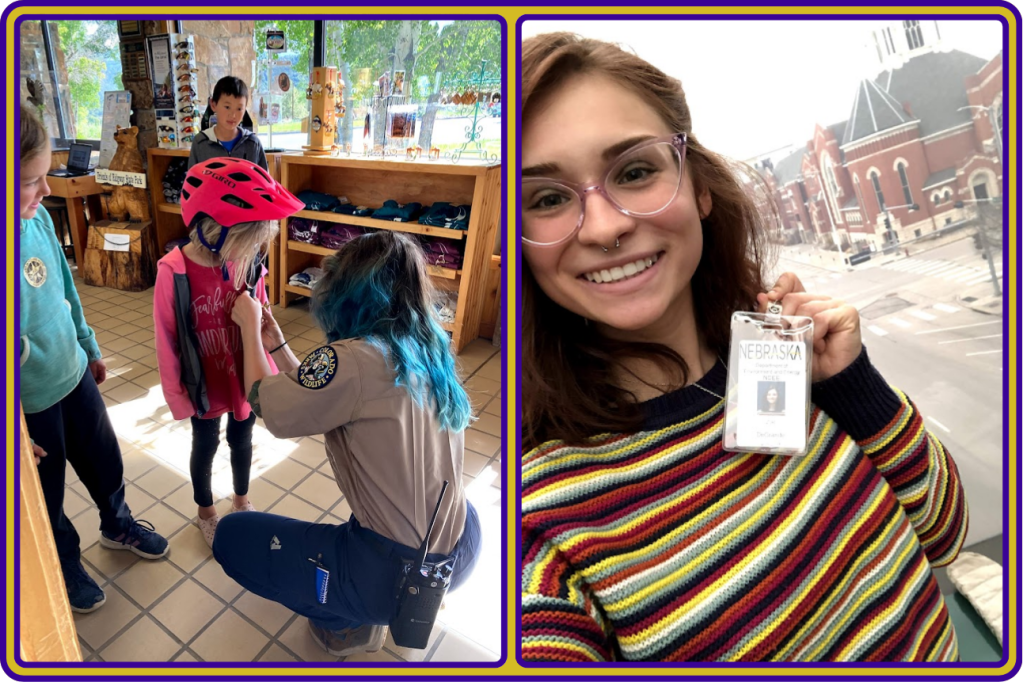
Right: Author’s first day at the Nebraska Department of Environment and Energy. Photo courtesy of Zoe DeGrande, shared with permission.
“Although the park was small, we made mighty efforts toward its protection and conservation, together with our local partners.”
“My dedication to environmental conservation and my experience in similar working conditions have prepared me for the demands of this role.”
I have written hundreds of variations of this sentiment in my cover letters and job applications. “Conservation” and “protection” were my dogma—the very reasons I pursued work in the environmental field. I always started my prospectuses with the golden rule of camping: leave it better than you found it. I presumed that within the pedagogy of conservation science, a framework of improvement would be central. But the hope I was taught in school about environmental conservation, after a little practice, feels embellished.
In elementary school, when the planet first reached seven billion people, in class our teacher told us how the earth could still sustain all seven billion of us, and small steps like switching to an LED light bulb, recycling, or riding your bike to school can keep global warming at bay. When I was in college, the narrative of environmentalism in the United States demonstrated action and progressive policy—people were being harmed by inaction, and so our government took action. My public education taught me about figures like Gifford Pinchot and Teddy Roosevelt, who advocated for the preservation of our natural resources. Learning about Rachel Carson’s Silent Spring and the 1969 fire on the Cuyahoga River that motivated the Clean Water Act and Nixon’s formation of the Environmental Protection Agency (EPA) taught me that when things get bad, we could trust experts and politicians to work in our best interest. We may not have listened to the people we colonized, whose culture of reciprocal respect for the planet was incompatible with our ambitions of grandeur, but at least some actions were taken. I entered the workforce eager to create positive change, inspired by the words of John Muir: “The battle for conservation must go on endlessly. It is part of the universal warfare between right and wrong.” Yet one thing I don’t recall learning in school was the original mission of the EPA: to “create and maintain conditions under which man and nature can exist in productive harmony,” and to “assure for all Americans safe, healthful, productive, esthetically and culturally pleasing surroundings.”
The U.S. EPA further defines “ productive harmony” as maintaining the conditions that fulfill both social and economic requirements for the present and future, something which we commonly use to define sustainability today. However, this approach often results in regulating pollution to be within a particular range deemed “safe” or reasonable, and there is good reason to question whether that should be considered sustainable in the long run. It may work well for development today, but over time how can it be good for the generations of people that are exposed to pollutants?
Now, after holding several positions in the conservation field, it seems to me that we continue to focus primarily on the idea of “productive harmony” rather than some of the other ideas in the EPA’s mission. Despite some success, we seem to generally be falling further behind as things become more dire in our growth-hungry world. I kept loyal to my mantra—leave it better than you found it— while seeing little change in the landscapes I worked in, and even less change in the frameworks or systems that shaped those roles.
In the United States, we often sing the praises of activists from early in our environmental movement—Pinchot, Roosevelt, and others. We applaud our ability to react to our environmental transgressions with evolving conservation policies and practices. However, my experience in the field shows that we have only become more comfortable with degradation, not better at stopping or reversing it. America stands on old legacies for credibility, but in practice, resources continue to be liquidated to accommodate economic growth. At best, we accept the stagnation of current practices and sit comfortably with how things are. Flint, Michigan is still fighting for clean water. Biden promised to be the “greenest president” and to reign in drilling on federal lands and instead settled for a higher entry fee. At the last minute before elections last year, Kamala Harris flipped her position on banning fracking, and I do not feel I need to go in depth on the agenda of the Trump Administration.
In my experience at the state level as an Environmental Compliance Specialist and Park Ranger, I believed I was living out the “conserve, protect, sustain” mantra that I’d embraced in college. But I soon realized the roles I had worked so hard to attain were out of sync with reality—offering only a tired echo of the passion and purpose that once drove the early environmental heroes we admire. The jargon of our policies and protections proudly touts sustainability and a commitment to future generations, while simultaneously championing a growth-driven market system. At some point, these priorities will collide, and their ability to coexist will come to an end.
To be clear, I loved these jobs, but like the girl in a horror movie, running from the monster, something tripped me up and made me look back. Adam Smith’s “Invisible Hand” crept in, revealing that the ideals of conservation and protection are compromised to nurture neoliberal growth and development rather than flourishing healthy ecosystems and communities.
After working as an Environmental Compliance Specialist for the Nebraska Department of Environmental Quality (changed to the Department of Environment and Energy during my interim), I was completely disillusioned. My entire education taught me about undoing anthropogenic blunders through remediation and regulation—the careful balance of providing for society and simultaneously maintaining the environment for the health and well-being of society.
At one point, I was on the Green Grants team, the department that evaluated grant proposals based on how well the proposed grant adhered to the concept of “Reduce, Reuse, Recycle.” Some of our funds were federal, and some were from the Nebraska Environmental Trust, whose mission was to conserve, enhance, and restore Nebraska’s natural environment. We were told to prioritize ‘green ethanol’ grants for the installation or addition of ethanol gasoline pumps. Besides the fact that studies have suggested that ethanol enriched gasoline may not be better for the environment (it may be more carbon-intensive than gasoline due to emissions resulting from land use changes to grow corn), we were directed to award $3 million to further promote such projects in lieu of other applications that directly benefited other communities in Nebraska. This shift made sense when I learned that the biofuels industry spent $800 million nationally in 2020 lobbying for additional COVID-19 relief, biofuels infrastructure subsidies, and production subsidies. In 2016, the executive director of the Association of Nebraska Ethanol Producers (ANEEP), wrote that the organization could bolster Nebraska’s biofuels industry by prioritizing relations with the state elected officials and building a modern rebranding effort to present Nebraska’s ethanol industry as underutilized in the national renewable fuel issue.
My first project involved researching every state’s Voluntary Cleanup Program, which focuses on remediating Brownfields—a property contaminated with hazardous substances that makes reuse difficult—to explore how our department could encourage broader participation by offering incentives and technological support to communities without any net increase in our budget. At the time, there were many efforts we could have made in order to incentivize entities to remediate and repurpose sites across Nebraska rather than lay dormant and contaminated. When I presented a month’s worth of research on what other states were implementing and how we could improve participation, my supervisor said we were going to simply revamp the website instead, since reorganizing the program and shifting funds would have been a lot of work, and my section supervisor was only a year away from retirement. At that moment, I felt that tangible opportunities to improve sustainability efforts in the department’s program were being reduced to a simple matter of rebranding and marketing rather than facilitating organizational changes that would directly target environmental degradation.
I won’t deny that the Nebraska Department of Environment and Energy (NDEE) fulfilled its duty to monitor and enforce contamination cleanup; permits were issued for polluting entities, Environmental Impact Statements were written and filed, and cleanup meetings with consultants for Nebraska’s 17 active Superfund sites were regular. However, these supposed successes felt more like we were mere cogs in a system of environmental upkeep rather than true public servants—we filed reports, attended meetings, and then went home.
Working at the NDEE was my first job in conservation, and it quickly challenged the trust I had in the system that I was taught to believe in. The conservation approaches that I encountered felt more performative than aligned with the Pinchot-style ethics I absorbed during my education. Our environmental laws and policies born out of crises were once essential for preserving natural resources, but over time we’ve come to mistake regulation for sustainability. In reality, regulation seems to often breed complacency, and has allowed industries to market mere compliance as environmental responsibility.
I left environmental compliance for a role as a Park Ranger, with the hope that I could pursue the greater goal of conservation more directly, with my feet on the ground. As a Ranger working in a park system that was created to be preserved for all future generations, my new motto became conservation through habitat management education.
However, rather than engaging the curiosity of visitors and expanding their knowledge and relationship with nature, reminders to “keep your dog on a leash” and “stay on the trail” were my primary tools of protecting the natural environment I worked in. While I agree with the role of state and national parks as a place to enjoy, appreciate, recreate, and educate, in my experience they are increasingly catering to human interests rather than preserving the habitats they set out to protect.
During my stint, there were plans to uproot several acres of semi-desert shrubland to add a new camping area for large groups. The addition was completed in 2024.
The hydropower dam in the park has sold renewable energy credits to the towns of Telluride and Aspen, which are used to bolster the towns’ sustainable energy portfolios while also repaying the debt for the hydropower project for the tri-county. While this system is not necessarily negative, it degrades the mission and foundational goals of state and national parks, turning the lands into sources of economic value and profit rather than places of recreation, appreciation, and education. State and national parks were established to preserve natural landscapes for their intrinsic ecological value, offering the public a chance to experience and learn from nature without degrading it. In Teddy Roosevelt’s 1903 speech at the Grand Canyon he pleaded,”Leave [the land] as it is. You cannot improve on it. The ages have been at work on it, and man can only mar it. What you can do is to keep it for your children, your children’s children and for all who come after you.”
The mission of the Park Service has traditionally been separate from our capitalist system, intended to be a mission that is not bothered or interrupted, but simply exists in perpetuity. Yet over time, that sentiment has eroded—much like the environment itself—as priorities have shifted from preservation to recreation, tourism, and economic gain.
I realize my experience is not universal. My perspective is shaped by my privileges—being white, educated, and working within predominantly institutional or government settings. I recognize that others in the environmental field, particularly those from Indigenous communities, frontline populations, or historically marginalized backgrounds, may have entirely different relationships to land, conservation, and environmental work. Their voices, often underrepresented in mainstream narratives, bring critical knowledge and lived realities that challenge and enrich the dominant frameworks I was trained in.
What I have come to realize is that the language I have relied on—“conservation” and “protection” —have been co-opted, diluted, and repurposed to fit systems that prioritize economic growth over ecological integrity. My professional journey has forced me to confront the uncomfortable truth that these words often serve as a veneer for inaction or, worse, for enabling the very degradation they claim to oppose. The jobs I once aspired to, and eventually held, mirrored a broader cultural performance of environmentalism—one that is heavy on symbolism and light on substance. Capitalism plays a central role in shaping the environmental field, often reframing conservation through the lens of profit and growth rather than ecological well-being. It has commodified language like “protection” and “sustainability,” using them to maintain appearances while continuing extractive and inequitable practices. This economic system privileges symbolic gestures over systemic change, sidelining voices that challenge its foundational priorities.
“My professional journey has forced me to confront the uncomfortable truth that these words often serve as a veneer for inaction or, worse, for enabling the very degradation they claim to oppose. The jobs I once aspired to, and eventually held, mirrored a broader cultural performance of environmentalism — one that is heavy on symbolism and light on substance.”
If there is to be any meaningful change, it must begin with a profound reflection upon how we put these concepts into practice, who they serve, and whose voices are included in shaping their meaning. Without that, we are only preserving illusions.
Author’s note: I originally wrote this piece during the first month of Trump’s second term, before many environmental protection organizations and frameworks had been blatantly targeted. While this article was written with a critical mood, I now contemptuously include this note as critical environmental policies and scientific truths are being actively dismantled.
 Currents