Written by Amie Kusch
Over this past year, I raised funds for the American Lung Association through its Climb for Clean Air initiative. The program highlights how climate change worsens air quality—through wildfire smoke, heat, and pollution—which directly impacts lung health. As an incentive for the initiative, volunteer fundraisers are offered an opportunity to climb Mount Rainier to bring attention to the cause. This is my account of the climb and the reflections it inspired…
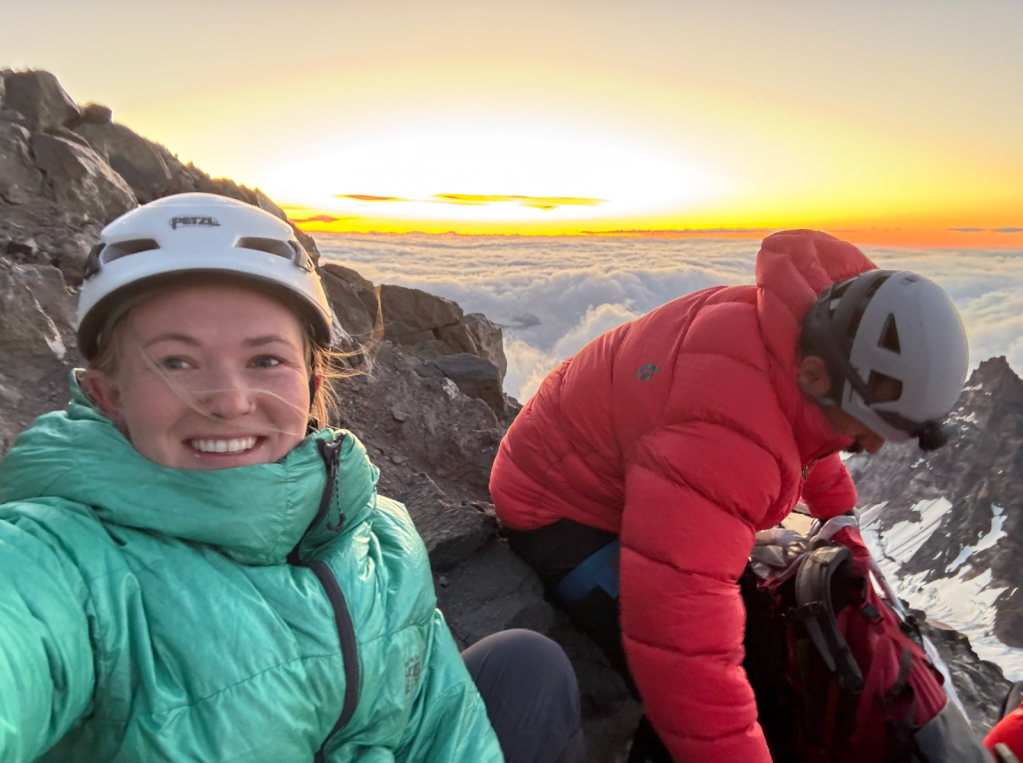
“Sometimes the mountain says no.” I held my breath. “And today she’s saying no.”
Those were the words of our guide as we rested at 12,300 ft around 4:45 a.m. atop Disappointment Cleaver on Mount Rainier. The name fit perfectly, and so did the feeling: disappointed. Fifty-mile-per-hour winds whipped through my three layers of jackets and around my down-stuffed hood. I turned my head and watched as reds and yellows illuminated the deep-blue sky, while peaks below me pushed through the cloud inversion.
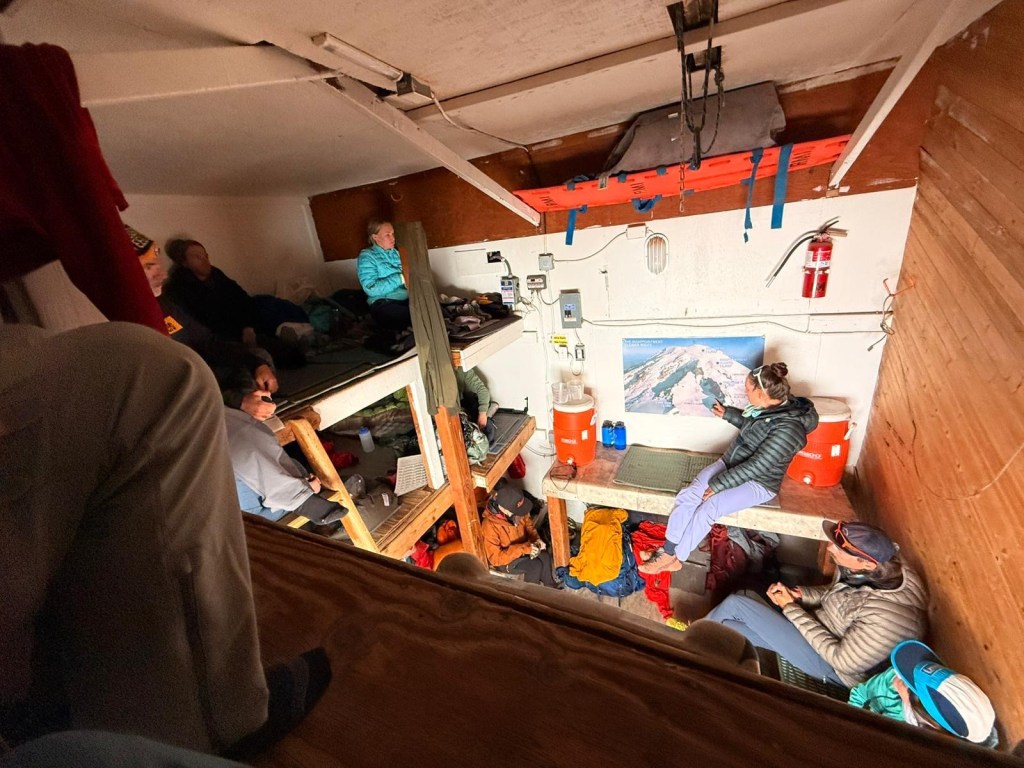
Four hours earlier in the climbers’ hut, we were woken by the clanking of carafes filled with boiling water and a cheerful “good morning.” That was the cue for me to stop tossing in my sleeping bag and start pulling on the clothing and gear I had laid out the night before. My body was sore from yesterday’s climb from Paradise to Camp Muir, but my mind was on full autopilot. I slipped my avalanche beacon over my head, adjusted it to my chest, added a jacket, and stepped outside.
The moon shone bright, lighting the camp and guiding me to a rock where I sat to eat a granola bar. My heart began to pound. The countdown had started. I had about an hour to finalize my pack. The guides’ instructions replayed in my head as I organized it carefully. With most of my cold-weather gear already on, the pack felt much lighter than yesterday. I took the last bite of my granola bar and adjusted my crampons, clawlike metal traction devices strapped to my climbing boots. With shaky hands, I tightened them as much as I could. Soon, others emerged from the hut, sending another jolt of anxiety up my spine. Time seemed to speed up. I layered on the rest of my gear and switched on my headlamp.

“Ready to go?” my guide asked. With a nod, I followed her. In the beam of my headlamp, I began piecing together the route that was described to us using a map taped up in the hut the night before. She threaded the rope into the metal carabiner on my climbing harness, locking me into our rope team and then to herself. Ice axe in one hand and trekking pole in the other, we set off across Cowlitz Glacier.
The silence pounded in my ears. With each step, I heard only my own heavy breathing and the crunch of snow and ice beneath me. I kept my eyes on the rope, careful not to catch it with the jagged points of my crampons, not thinking much about what lay ahead.
Abruptly, we hit it–bare rock. There was a stark line where the glacier ended and the dusty volcanic rock of Cathedral Gap began. The slow start along the glacier path was over, and the true climb had begun. Every move turned into a steep scramble, the claws beneath my boots scraping as I hauled and hoisted myself higher along the tight switchbacks. Loose scree slid underfoot as I searched for anything solid enough to grip. Adrenaline pumped through my body, and the same repetitive questions raced through my mind: Why did I sign up for this? Is the rope too loose? Is the rope too tight? Can I keep going? What if I slow down and make everyone fall?
With those thoughts swirling and only enough light to see a few feet ahead, I was surprised when the guide called for our first stop. I quickly took off my pack, threw on my parka, drank some water, and ate a bit of food. My guide assured me that if I felt comfortable, we were on track to keep going. This helped my fleeting confidence. I looked ahead to see an otherworldly scene: arches of hard-packed snow curving over the route like waves frozen mid-flow. My headlamp caught the blue-white glow in the hollow spaces, turning the way forward into a quiet, glittering landscape.
When it was time to start the next leg, we switched to a different guide so ours could escort a teammate back to camp. This made my mind-numbing reflections resurface. Can I keep going? I thought so. I sealed my water bottle, stowed it in my pack along with my parka, and hoisted the weight onto my back.
As we wandered through the frozen waves of Ingraham Glacier, I knew this next stretch brought new challenges: falling rock, overhanging seracs, and our first crevasse crossing. We moved quickly and silently on a shortened rope, listening for debris that could be tumbling towards us from above. This was the part of the climb that I was most excited about, but also truly dreaded with my fear of heights. Stepping over a gaping crack in the glacier made my whole body fill with the buzzing of nerves. The moment my foot hit the wooden plank, I peered straight down into the frozen bottomless void. After taking some time to stare down into the abyss, I forced myself to move and scrambled across the man-made bridge.
Beyond the gap, we hit another snowless ridge, steeper than the last. I looked up with my light, exposing the climbers above. It seemed almost impossible that we would ever make it up to where they were. I focused on my breathing. My steps turned into powerful, awkward lunges, flinging my leg onto stone steps half the size of my body while keeping in mind that if I pushed off the wrong rock, I could send it barreling down towards those below me.
The wind started to pick up, and climbers who left earlier in the night started to pass us, descending from their unsuccessful attempt at the summit. My heart sank a little. We paused beneath a large outcrop to shield ourselves from possible falling rock while our guide admitted that we might face the same outcome.
The climb continued into even harsher wind. At this point, there was gravel in my mouth and eyes. With my helmet feeling like it was going to blow off my head any second, I squinted my eyes and kept climbing. The wind pressed against my whole body, and I pushed back against it while it threatened to take me right off the side of the mountain.
Every random gust felt stronger than the last, sweeping my breath away as we all synchronously braced into the side of the mountain. We continued to zig-zag up in this fashion as a bit of light began to creep into the sky, assisting my headlamp and revealing more of the route ahead.
We turned a corner, and I felt slight relief when my guide told us to sit and rest, repeating the same efficient routine of water, food, and warmth as before. The “rest area” was barely more than a shallow notch in the rock, tilted forward so that if you set a water bottle down, it would likely slide off into the dark and disappear. Still, with my legs heavy and my lungs aching for a normal breath, I sat and pulled on my parka.
My teeth chattered as my body shook from the cold. I watched each guide settle their rope team into the cramped space, then gather in a quiet huddle, their low voices and urgent gestures carried a hint of tension.
Positive thoughts drifted in. I reminded myself how hard the climb had been and that, although I was terrified, physically I felt fine and could continue that same exertion of energy to the summit. Eventually, I realized that our break felt longer than normal. I glanced over to the guides and saw frowns painted across their faces. They turned to us, and after four hours of a grueling trek, my guide uttered the phrase that sticks with me. Sometimes the mountain says no.
“Sometimes the mountain says no.”
I felt my body loosen up as disappointment crept into my chest. All that work … and yet I experienced quiet acceptance as I thought about what I had accomplished so far. I turned my head to see the painted sky. Those reds and yellows and pinks outlined the mountain peaks below us, and a calm feeling came over me. I was okay that the mountain was not in the mood to have us summit today.

As we began our descent, a heavy sense of exhaustion draped over my body. It was almost more difficult going down the cliffs than climbing up had been, and new thoughts filled my mind. I kept thinking about how remarkable it is that humans put so much effort into connecting with nature, the work of locating routes up the mountain so people can reach the top, and the way these guides know every feature as if it were second nature. They catch the smallest changes in the terrain and react within seconds. These thoughts whirled through my mind as I reflected on my own connection to nature.
I thought about how being in these landscapes makes me feel at home and fuels the urge I have to protect wild spaces. I thought about the bare rock and melting snow, and about the anxiety that fills my bones when I consider how climate change is already impacting this mountain and the wildlife and vegetation that call it home.
As the cliffs leveled back into the gentle snow-covered trail, I let my mind drift farther. When I set out on this climb, I knew I wanted to take away something from it. I assumed it would be the feeling of accomplishment that I got to the top. I wondered what the takeaway would be now that the summit was not an option. The phrase from earlier returned: Today she’s saying no.
Holding onto this phrase, I felt a small sense of relief. Earth has existed for 4.5 billion years. Humans have an enormous impact on its climate and the creatures that depend on it—and a responsibility to repair the damage, but nature is powerful and can say “no”, too, pushing back with its own strategies for resilience and recovery. It is humbling to be reminded that the earth and the species inhabiting it have their own ways of enduring. Leaning into this thought lends me a sense of hope and guidance as I navigate a career that will inevitably hit roadblocks. This climb is a fitting metaphor: the fight to protect our planet is an uphill battle that demands strength, and some days the effort will not end in success. But that does not mean the work is over or that we should concede. The peak is still there; we just have to continue to work towards it. It’s a reminder that while humans have a large responsibility to mitigate climate impacts, we are not in it alone.
“The peak is still there; you just have to continue to work towards it.”
 Currents