Written by Marisa Campbell
Fins with Fashion: Are Orcas Bringing Back the Salmon Hat?
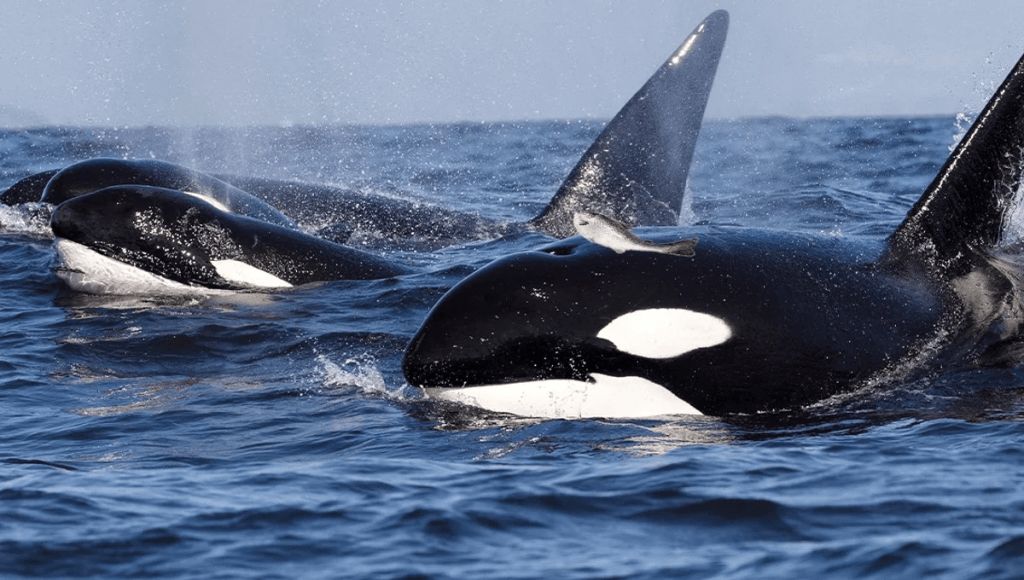
Southern Resident Killer Whales (SRKWs) are bringing back the BOLDEST hat of the 1980s, and it’s NOT a raspberry beret! With the rapid resurgence (and inevitable obsoletion) of 70s boho style, 90s minimalism, and Y2K kitsch, it seems like the 80s are the only recent decade of fashion that we haven’t recirculated into the rapid throwback trend cycle that has defined fast fashion in the 2020s. However, societies under the sea may be swimming ahead of this trend, with the killer whales of the PNW leading the pod in circulating 80s fashion back into the North Pacific Current. This year, we have seen a resurgence of the “salmon hat” trend that first emerged amongst the SRKWs in the 1980s. So, what is the history of this “trend”, and what might it tell us about the current state of SRKW culture?
The salmon hat fad first hit the fins of the PNW’s orcas in 1987, when a fashion forward female in K pod was seen carrying a dead salmon perched cranial to her dorsal fin. This bold hat was an instant must-have, spreading quickly throughout K, J and L pods. Fashion forward orcas across the entire SRKW population donned fishy fins until the fad faded out a year later. But this year, a member of J pod nicknamed “Blackberry” brought new life to the trend in a viral photo that made waves across the web. Since then, there has been one more sighting of a salmon hat this year. However, expert orca trend trackers warn against calling out the resurgence of the salmon hat as the next big thing in orca fashion. With just two sightings of the salmon hats, we can’t be sure whether this is a true fad, or just a fluke.
So what drives a fashion fad such as the salmon hat? All we can do is offer guesses, but what we know for sure is that orcas are capable of learning non-essential behaviors that amount to a culture all their own. Whether the hats serve a practical purpose, signify some sort of social status, or are just plain playful, the existence of fads amongst orcas demonstrates their complex learning and communication capabilities.
Self-Care from the Sea: Is Kelp Key to Silky Smooth Skin?
Self care is certainly something that we have seen prioritized in health and beauty trends of the 2020s. Furthermore, as more people are becoming acutely aware of how the toxins contained in beauty products are affecting our health and our environment, more consumers are making the shift towards products derived from natural ingredients. We are behind the times on this, as many species on Earth have mastered this art, as demonstrated by numerous examples within zoopharmacognosy (def: the behavior of non-human animals self-medicating through the selection of natural substances). Orcas are no exception, and have been observed engaging in an innovative new form of self-care – allokelping.
Allokelping, which describes the phenomenon of orcas rubbing each other with kelp, hit the Southern Resident self-care scene in the beginning of 2025; in an act of frisky foraging fun, orcas have been breaking off pieces of bullkelp and rubbing it on each other’s bodies. This might be the hottest orca trend of 2025, with one group of researchers documenting 30 allokelping spa treatments in just 12 days. Beyond the sense of social intimacy that can be gained from mutual massage, it is speculated that allokelping serves a purpose in skincare, as well. Individuals with rough skin or lesions are thought to engage in the behavior more frequently. This spa treatment at sea is a perfect example of tool-use amongst orcas, a behavior that is often used to indicate intelligence. If we were to use our smarts, as well, we would bring this trend terrestrial.
Are orcas onto something with kelp-based care? The many minerals and amino acids packed into kelp work to hydrate, brighten, and nourish skin; kelp has anti-inflammatory and anti-aging properties, as well. Kelp-based skin care is clean, sustainable, and effective—so I bet you are wondering where you can get your human hands on the sea’s secret skincare superpower! Check out SeaSoaked Skin Co., a woman-owned small business that uses sustainably sourced Alaskan kelp to create their luxurious skincare products. Whether you are of a society of the sea or find yourself landlocked, kelp-based skincare is a trend that we should not let fade into a fad.

The Problem with Pescatarianism: How Orcas’ Favorite Foods Might Shape Their Future
For our resident pods in the PNW, Chinook Salmon has always been their go-to meal; this diet is far more than a fad, it’s central to their culture and lifestyle. In fact, Northern and Southern Residents have evolved to only consume fish, distinguishing their cultural cuisine from that of the marine mammal-eating Bigg’s killer whales, nicknamed transients due to their nomadic lifestyle. Much like with humans, culture around food has a huge influence on the health and well-being of a population; so, let’s take a look at what these different odontocete diets can tell us about each population’s potential.
Bigg’s Killer Whales enjoy a carnivorous cuisine compared to the pescatarian diets of the Resident Orcas who also call the PNW home. Though the carnivore diet is controversial among humans, for transient orcas it seems to be paying off. Their population, though listed as threatened, is steadily growing. Surprisingly, the Northern Residents are in the same boat, despite sharing a more similar diet to the critically endangered Southern Residents. This difference, then, is not due to what they eat, but how they eat.
One huge cultural difference between us land-dwellers and killer whales is that they exist in a matriarchy. Resident orcas learn hunting techniques passed down from their matriarchs, so, naturally, the Northern and Southern populations have slightly different cultural norms around feeding themselves. For the Northerners, females lead the pod in hunting, capturing more prey than males — talk about girl power! However, this might actually have to do with weaponized incompetence on the part of young males (maybe our societies are more similar than we thought…). If a Northern male’s mother is still alive, they hunt less frequently while mom picks up the slack. To pile even more on their plate, Northern nursing mothers spend much more time hunting than their Southern counterparts. While I’m inclined to say that someone should tell these ladies to take a load off (and those boys to pick up the slack), these fierce females might actually be the reason the Northern Residents are thriving in comparison to their neighbors down south. Southern resident males catch three times as much prey as their female counterparts; given the status of their population in comparison to the Northern Residents, maybe female led foraging is the future for these fish eaters.

As we ring in the new year in 2026, we can look to our savvy sea friends for new years resolution inspiration. Whether you want to revive a bold trend yourself, treat yourself to a new skincare regiment, or diversify your diet, you can thank the orcas of the PNW for pointing you in the right direction.
 Currents