Written by Lou Guionnet
As someone who grew up loving the ocean and participating in beach cleanups along the coast of California, I’ve always had plastic pollution hovering in my mind. My family didn’t forgo plastic altogether, but we were mindful of it, or at least it felt that way. As with other households, we placed our waste into sorted bins, which were collected each week, trusting that the system functioned as it should. There was a landfill not too far from our neighborhood in Palo Alto; a mound the size of a small hill, but it wasn’t monstrous. Today, it’s a dry, grassy slope that offers visitors a magnificent view of the South Bay (Redwood City, Palo Alto, Mountain View, and Shoreline), and someday might have some beautiful, big oaks growing on it. Standing there, it’s easy to forget what lies beneath.
Waste doesn’t simply disappear—it’s buried, burned, or displaced. Many Palo Alto residents considered it a shame that the landfill was located next to a public park that serves as a vital habitat for migrating wildlife year-round. When they closed it, I never learned where my trash went next.
Plastic pollution isn’t a distant problem. It’s here, embedded in the places we live, recreate, and depend on.
Since moving to Seattle, I’ve wondered about waste management again. The Cedar Hills Regional Landfill receives more than 800,000 tons of waste from King County residents and businesses alone. Not all of this gets dumped in the landfill; some of it escapes the system, slipping into streets, waterways, and eventually the sea. I know, since I’ve picked it up myself. I’ve participated in two clean-ups led by Puget Soundkeeper. One was by kayak in Lake Union; the other was along the Elliot Bay Trail and Pocket Beach. Each time, there were more bags of trash than any of the volunteers or organizers would have hoped. These experiences made one thing clear: plastic pollution isn’t a distant problem. It’s here, embedded in the places we live, recreate, and depend on.
We’ve all seen the headlines and the alarmist titles telling us we’ve got plastic in our waters and in our brains, but what does that really mean? There is evidence of adverse effects, but most are difficult to pinpoint and isolate. At this point, all animals, including humans, are affected by many different pollutants, whether it’s air pollution, PCBs (used to enhance the properties of certain plastics that are extremely long-lived in the environment), or the chemicals found in household cleaning products [1]. These exposures can alter how our bodies function.
Plastic has become so ubiquitous that scientists struggle to find “control” organisms or locations in which microplastics are absent (and I’m not even getting into nanoplastics). As scientists try to better understand the effects of plastic, they find it impossible to compare anything with a “virgin” or non-plastic-polluted environment. Within our Salish Sea region, a single filtered water sample in the north near Vancouver contained an average of 3,200 plastic particles per cubic meter. Between 2014 and 2024, an average of 3,500 microplastics per square meter were found in benthic sediments around the Tacoma-Seattle area. Plastic concentrations vary across regions, with more populated areas having higher concentrations in sediments. This model shows the movement and distribution of microplastics in the Salish Sea.
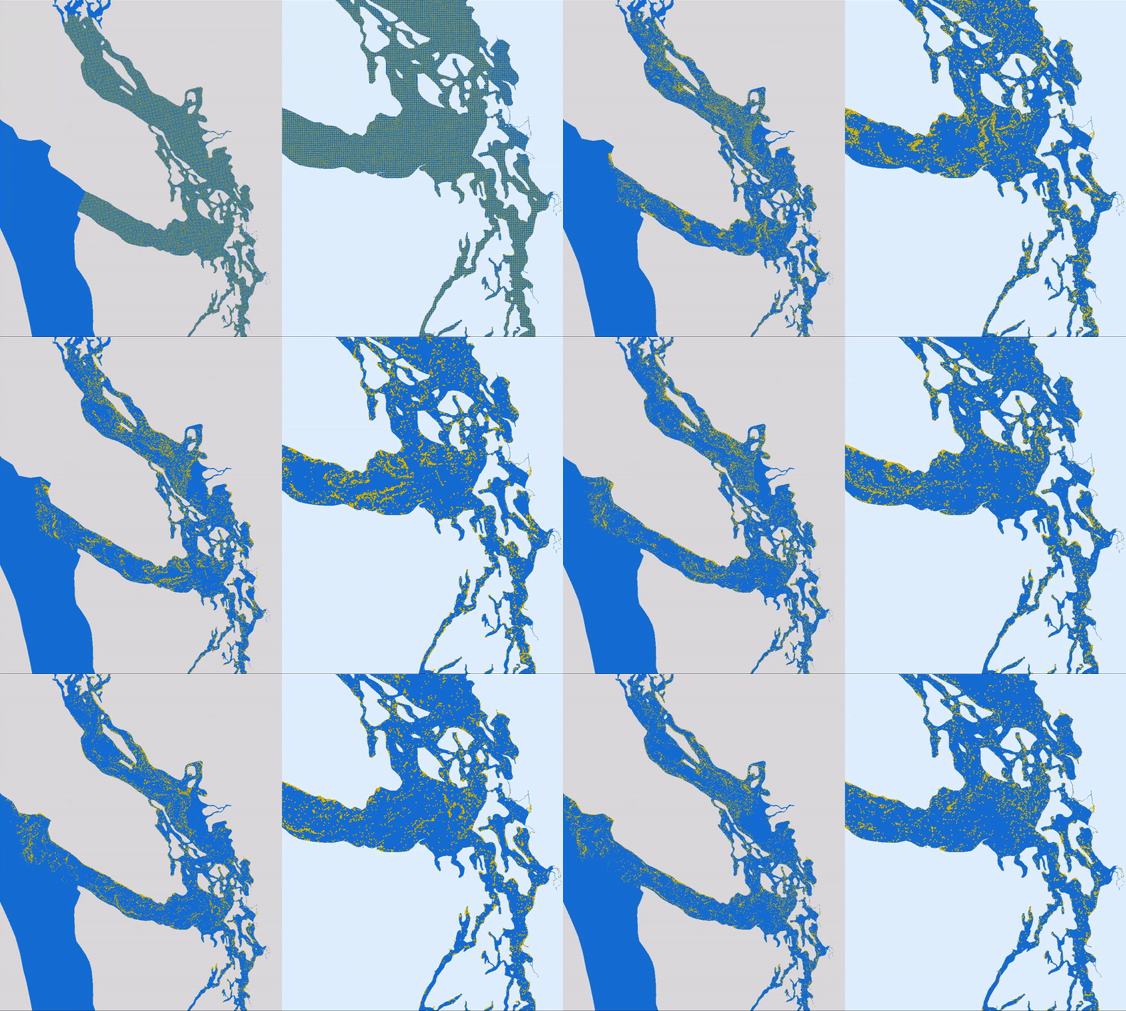
This intricate model of microplastic movement in the Salish Sea is invaluable for understanding microplastic distribution. These models show that crucial spawning and rearing habitats for important species such as the sand lance are at serious risk. They also underscore the importance of monitoring critical fish habitats, particularly considering the impacts of microplastics on biological processes. As someone who loves the ocean and the animals that call it home, it’s disturbing to know these animals are also paying the price for my comfort and convenience.
From the smallest bacterial communities, where pollutants can eradicate whole species from this diverse and thriving microscopic world, leaving only a select few to continue [2]. To mussels, where more than half of a select sample had 1.92 microparticles of plastic in their systems [3]. Clams, crabs, and urchins have also been found with microplastics in their tissues. Herring, Pacific sand lance, and salmon are among the Salish Sea fish species that have been analyzed for microplastic ingestion [4, 5]. In larval and juvenile herring, microplastic concentrations were low at 0.0017 and 0.089 individual microplastic particles per age group, respectively. While sand lance had a 27% ingestion rate, salmon (Pink, Chinook, and Coho) had a 77% ingestion rate. This means that more than three out of every four sampled salmon had plastic in their digestive systems, fish that many of us love to eat regularly. As we move up the food chain, this trend intensifies through a process known as biomagnification, in which plastics become increasingly concentrated in larger animals.
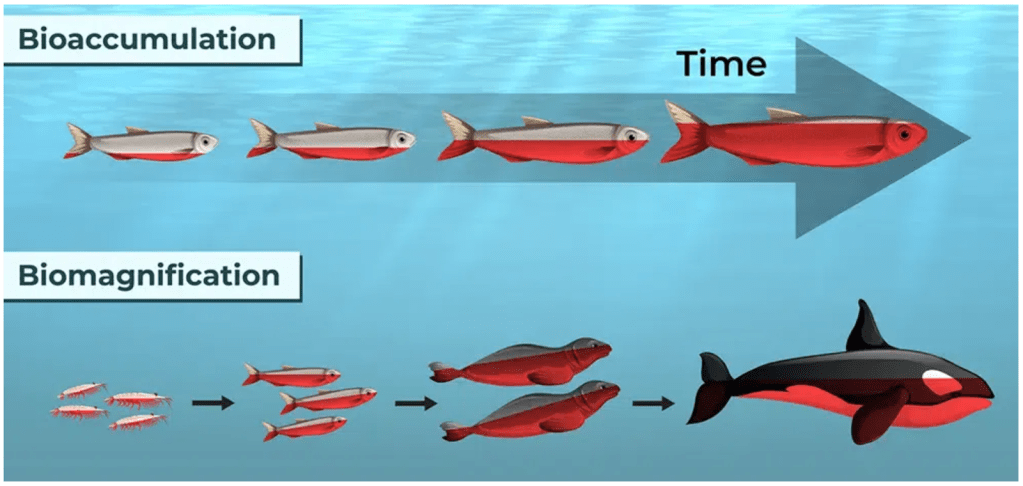
Taking a look at the Salish Sea’s charismatic megafauna, researchers have found that microplastics do not simply pass through their bodies. A unique technique mimicking the digestive systems of Grey Whales showed that microplastics can accumulate in gut tissues, leading to long-term exposure. As these massive creatures dive to the depths of the estuary to rummage through seafloor sediments in search of food, they disturb areas where microplastics are concentrated and ingest these particles along with their prey. Buildup of plastic in their gut can lead to sublethal effects, impacts that don’t immediately kill the animal but can reduce growth, impair reproduction, and limit overall health [6]. Similar concerns exist for orcas. When comparing 33 fecal samples from North Pacific Resident killer whales, researchers found an average of 82 microplastic particles per sample, though counts varied widely between individuals.
Marine animals are affected by plastic pollution that enters marine ecosystems through gaps in our waste management systems. Plastic has been found in the digestive tracts, livers, and tissues of marine species throughout the food web…mirroring what researchers are discovering in humans. But, unlike us, marine life has no use for plastic.
Shifts in both policy regulations and consumer behavior are needed to prevent further plastic pollution.
Plastic is deeply embedded in modern societies. We rely on plastic for comfort and ease in our daily lives; in its various uses, it provides convenience, safety and, in some cases, survival. Our dependence is reinforced by the oil and gas production industry, which continues to expand plastic manufacturing rather than slow it down. Despite political support for recycling, sustainability, and domestic plastic production, the United States has made little progress toward a circular economy. Recycling infrastructure remains outdated, innovations are underfunded, and only about 5-6% of plastics are actually recycled [7]. Shifts in both policy regulations and consumer behavior are needed to prevent further plastic pollution.
Innovative solutions to plastic pollution do exist. The Ocean Cleanup Project, for example, is tackling the daunting challenge of cleaning up the Great Pacific Garbage Patch. It is simultaneously implementing measures to prevent pollution at its source by intercepting waste in major rivers worldwide. Other efforts focus on preventing microplastics from entering the environment. Viridis Research has developed a prototype that can be integrated into washing machines to break down microplastics via electro-oxidation, thereby converting them into nitrogen, carbon dioxide, and water.
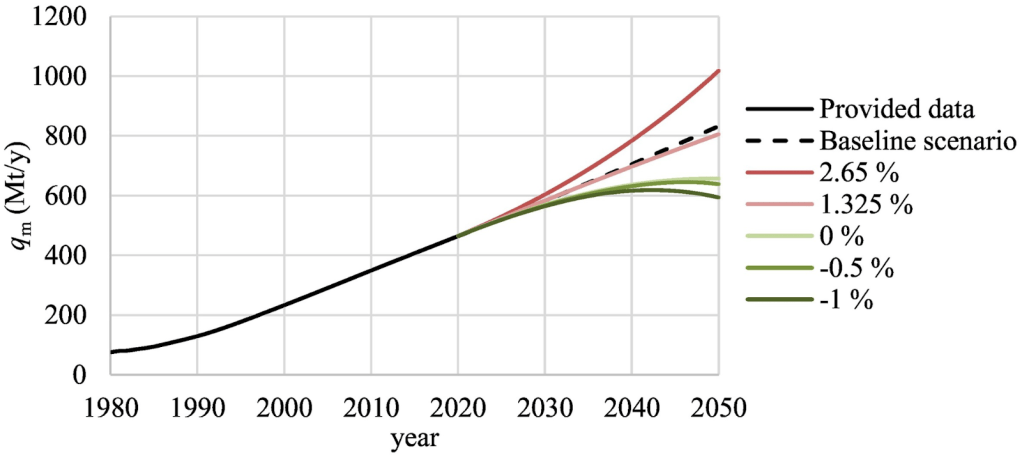
While these promising technologies are inspiring, they require sustained funding, thoughtful implementation strategies, and consumer adoption to be fully functional. More importantly, these approaches do not solve the root of the problem: the continued production of virgin plastics. Global projections show no signs of slowing, as plastic use is expected to rise sharply in the coming decades, even in scenarios where international commitments are met. Efforts from governing bodies through the Basel Convention aim to tighten controls on plastic pollution, yet the United States has repeatedly declined to participate, citing legislative barriers. Technological progress is racing against systems that continue to produce more plastic than they can manage.
Looking at this from a global scale can be overwhelming, especially in the context of more pressing current events. How can we do our part socially and environmentally? We can continue to hold ourselves, others, the industry, and the government accountable. Consider your daily habits; where can you make that substitution? Organize your clean jars and bring them to a bulk store such as PCC. Visit a local zero-waste store, such as Mimi’s Zero Waste Store, Ravenna Refills, and PUBLIC in Seattle. Check your recycling route to see what types of plastic are accepted at your recycling facility. The resin code stamped on the plastic, marked with a small recycling triangle, can be misleading; it’s there to draw attention to the number that identifies the type of plastic the specific container is made from. Generally, only containers made of plastics 1 and 2 are easily recyclable. When in doubt, check the King County Recycling webpage or your local recycling facility for more information. Joining community clean-ups, or going out in your neighborhood with gardening gloves and a bucket to pick up the pieces of trash you pass by every time you go for a jog or a bike ride, can feel rewarding. As solitary as it might feel, know that many others join you in solidarity, for the planet, for the people, and for the future.
References
[1] Ziani, K., Ioniță-Mîndrican, C.-B., Mititelu, M., Neacșu, S. M., Negrei, C., Moroșan, E., Drăgănescu, D., & Preda, O.-T. (2023). Microplastics: A Real Global Threat for Environment and Food Safety: A State of the Art Review. Nutrients, 15(3), 617. https://doi.org/10.3390/nu15030617
[2] Tagg, A. S., Sperlea, T., Hassenrück, C., Kreikemeyer, B., Fischer, D., & Labrenz, M. (2024). Microplastic-antifouling paint particle contamination alters microbial communities in surrounding marine sediment. Science of the Total Environment, 926, 171863. https://doi.org/10.1016/j.scitotenv.2024.171863
[3] Harris, L. S. T., Phan, S., DiMarco, D., Padilla-Gamiño, J. L., Luscombe, C., & Carrington, E. (2023). Microparticles in marine mussels at regional and localized scales across the Salish Sea, Washington. Marine Pollution Bulletin, 196, 115609. https://doi.org/10.1016/j.marpolbul.2023.115609
[4] Mahara, N., Alava, J., Kowal, M., Grant, E., Boldt, J., Kwong, L., & Hunt, B. (2022). Assessing size-based exposure to microplastic particles and ingestion pathways in zooplankton and herring in a coastal pelagic ecosystem of British Columbia, Canada. Marine Ecology Progress Series, 683, 139–155. https://doi.org/10.3354/meps13966
[5] Selden, K., & Baker, M. R. (2023, September 4). Influence of Marine Habitat on Microplastic Prevalence in Forage Fish and Salmon in the Salish Sea. Social Science Research Network. https://doi.org/10.2139/ssrn.4560914
[6] Hawkins, S., Allcock, A., Bates, A., Evans, A., Firth, L., Mcquaid, C., Russell, B., Smith, I., Swearer, S., Todd, P., Yu, S.-P., Cole, M., & Chan, B. (2021). Oceanography and Marine Biology An Annual Review Volume 58 Chapter 7 Review: Effects of Microplastic on Zooplankton Survival and Sublethal Responses (CC BY-NC-ND 4.0). https://library.oapen.org/bitstream/handle/20.500.12657/43149/9780429351495_C007_OA.pdf?sequence=1&isAllowed=y
[7] Dokl, M., Copot, A., Krajnc, D., Fan, Y. V., Vujanović, A., Aviso, K. B., Tan, R. R., Kravanja, Z., & Čuček, L. (2024). Global projections of plastic use, end-of-life fate and potential changes in consumption, reduction, recycling and replacement with bioplastics to 2050. Sustainable Production and Consumption, 51, 498–518. https://doi.org/10.1016/j.spc.2024.09.025
 Currents