Written by Abigayl Farr
Sharks have survived millennia of hardships, surviving environmental change, mass extinctions, and shifting oceans. Their long evolutionary history has shaped the structure and function of marine ecosystems. These predators play an underappreciated role in maintaining ecological balance around the world, including within Puget Sound, and we risk losing their ecosystem services as their populations decline in the face of changing oceans and growing human pressures.
History of Sharks
Sharks have been around for over 450 million years, surviving all five major extinction events. The Late Devonian mass extinction, which killed off 75 percent of all Earth species, led to the “golden age of sharks”— a time when sharks dominated the oceans, and many new species emerged. 140 million years later, sharks were some of the few species to survive the Permian mass extinction that killed 96 percent of marine life; while many of the largest sharks were killed during the End-Cretaceous extinction, smaller shark species again survived. While there is no definitive explanation as to how sharks were able to survive each of these extinction events, leading theories suggest that their food generalist diets along with their ability to live in different parts of the water column likely made them more resilient to changing ocean conditions.
Traits that once enabled sharks’ survival through mass extinctions will not help them persist against today’s intensifying human-driven threats.
Within the last decade, scientists have seen a rapid decline in shark populations around the world. Each year, humans are the cause of over 270 million shark deaths worldwide. Some shark populations have decreased by 70 percent, with one-quarter of all shark species considered threatened by extinction. Because sharks grow slowly, reach sexual maturity late in life, and reproduce infrequently, their populations recover at very low rates (1.7–14%) following declines. Traits that once enabled them to persist through past mass extinctions offer little protection against today’s rapidly intensifying human-driven threats.
Importance of Sharks in Marine Ecosystems
Sharks are widely misunderstood, and their ecological importance is generally unknown by the public. As apex predators, sharks play a key role in maintaining functional ecological communities. Top-down predators regulate populations at each level of the food chain. By keeping mid-level predator populations in check, sharks indirectly protect smaller organisms from being overconsumed. In areas where sharks have been removed from the ecosystem, researchers have observed increases in mid-level predators such as lingcod. These mid-level predators reduce populations of herbivores that normally graze on algae, allowing algal communities to expand unchecked. As algae proliferate, kelp forests experience reduced growth, slower recovery, and increased replacement by turf algae (Figure 1). Through this cascading chain of trophic interactions, sharks help maintain the balance necessary for kelp forests to thrive. This is essential to ecosystem health because kelp forests provide critical habitat as nursery and breeding grounds for many marine species like rockfish, salmon, and abalone. The presence of sharks ultimately maintains a diverse and resilient kelp ecosystem.
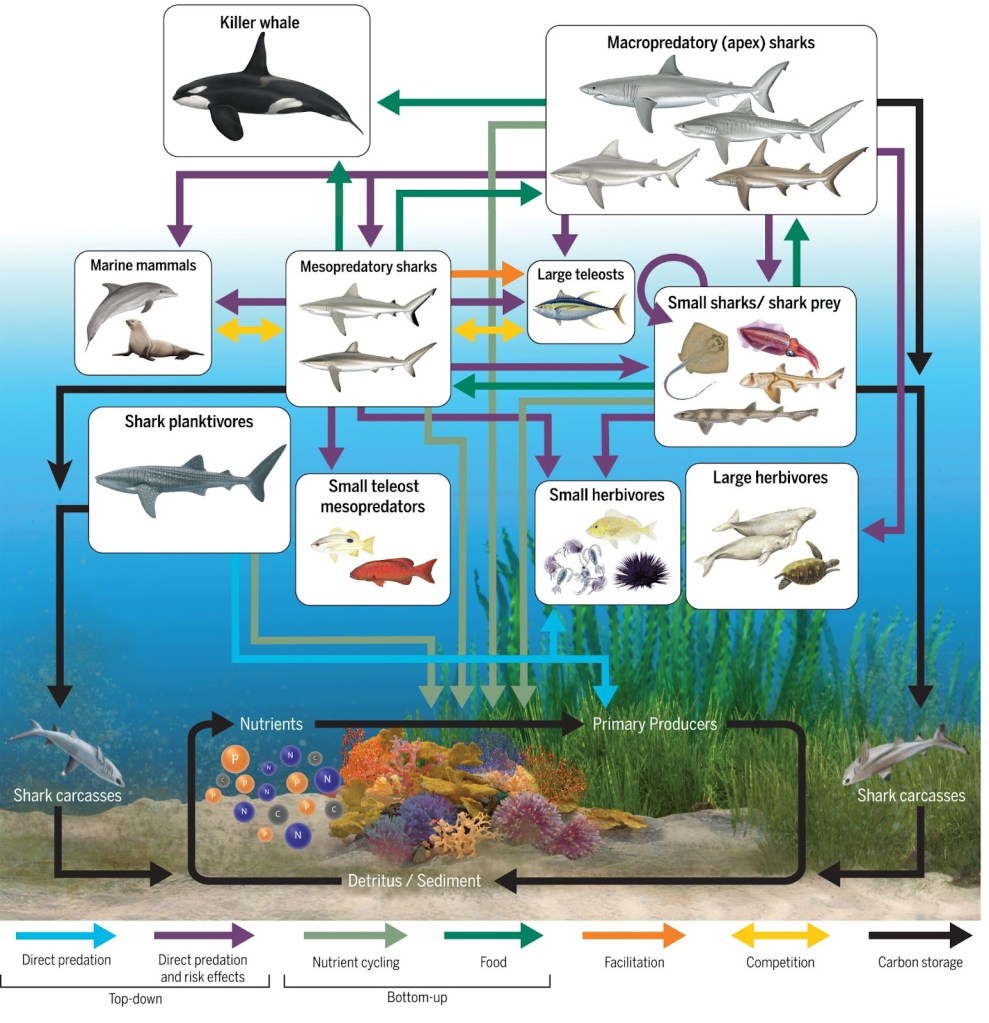
The intimidating presence of sharks in an ecosystem influences biodiversity by creating a fearscape (fear landscape). This is a phenomenon where the presence of top predators alters the behavior, habitat use, and movement of other marine species. The fear of predation causes individuals to move frequently, which prevents one species from dominating and allows for the coexistence of multiple species. Diverse habitat usage lowers the risk of degradation for similar reasons stated above.
Another way sharks maintain a healthy ecosystem is by removing individuals who are sick, weak, aging, or diseased. By preying on vulnerable animals, sharks can reduce the spread of disease and prevent less fit individuals from passing on disadvantageous genes to future generations, ultimately strengthening the gene pools of their prey species. Research also suggests that the presence of sharks can indirectly improve fish health: when fish accelerate to evade predators, the increased swim speeds may help dislodge external parasites from their scales. Parasites can be detrimental to fish growth and survival so if they can outswim the shark, they may ultimately benefit from this predator-driven “health check.”
Aside from physical impacts sharks have on their ecosystem, they also influence their environment on an abiotic level. Large marine animals such as sharks are effective carbon sinks. A carbon sink can be natural or man-made through the process of absorbing and storing carbon dioxide from the atmosphere. Sharks accumulate carbon by preying on species that eat photosynthetic plants and store carbon in their body tissues (Figure 1). About 10 to 15% of a shark’s body mass is carbon. After a shark dies, their body sinks to the bottom of the ocean, where much of the carbon decomposes and becomes sequestered into sediments (Figure 1). Additionally, sharks enhance blue carbon — carbon stored in marine ecosystems — by limiting the amount of predation on kelp forests and eelgrass. Removing sharks from ecosystems decreases the amount of carbon the ocean naturally holds, resulting in increased carbon dioxide released to Earth’s atmosphere.
Another less visible impact is the nutrient cycling sharks provide to their ecosystems (Figure 1). Sharks migrate throughout the ocean, hunting for prey and shifting habitats during seasonal changes. Bluntnose sixgill sharks move from deep waters during the day to shallower waters at night. Moving nutrients from deeper within the water column to shallower zones promotes a healthy ecosystem by supplementing existing nutrient pools and redistributing energy across ecosystems, supporting productivity in ways that might not occur through physical processes alone.
Sharks in the Puget Sound
While Washington’s Puget Sound is best known for salmon and orcas, at least 12 species of sharks have been documented in our waters. The most common species include the bluntnose sixgill (Hexanchus griseus) (Figure 2), spiny dogfish (Squalus suckleyi) , salmon (Lamna ditropis), and soupfin (Galeorhinus galeus) sharks. Aside from the species that live here year-round, a few species —like the basking sharks (Cetorhinus maximus), broadnose sevengill (Notorynchus cepedianus), and thresher sharks (Alopias vulpin) — are occasionally sighted.
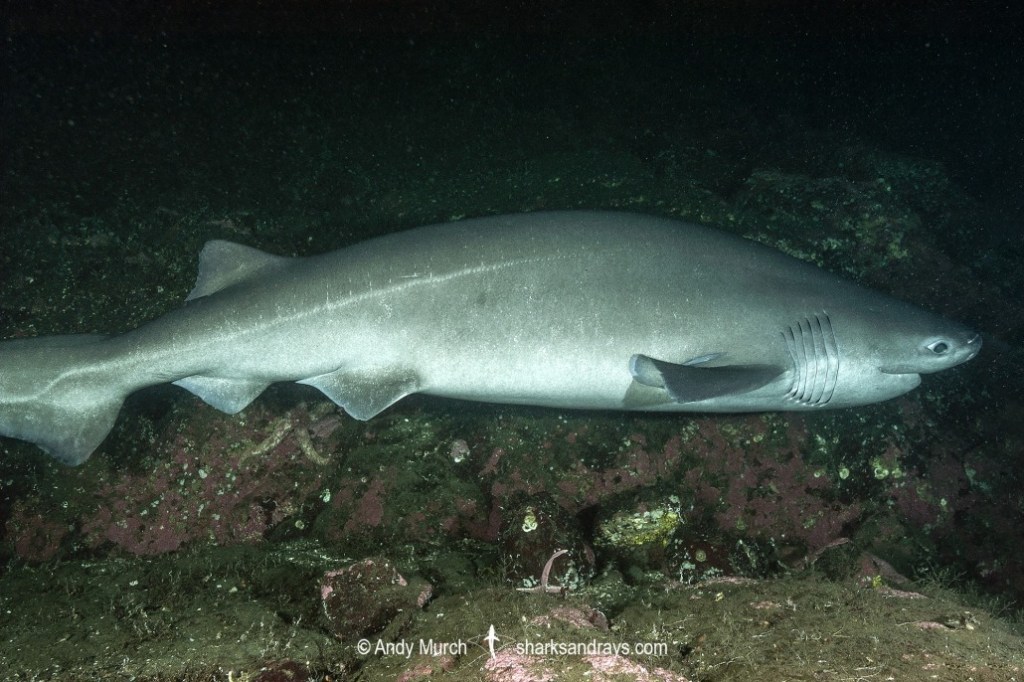
The bluntnose sixgill shark is one of the few shark species in the Puget Sound that has been studied. One study by the National Oceanic and Atmospheric Administration’s (NOAA) Northwest Fisheries Science Center found that bluntnose sixgill pups use the estuaries of Puget Sound as nursing grounds, living here until they mature. Researchers tracked these sharks and learned that as these pups start to mature, they tend to spend more time swimming along the waterfront in Seattle. While these sharks have been known to come to the Puget Sound to give birth, their population peaked between 1999 and 2007. After 2007, a sharp decline was observed. There have been few reported sightings from divers and fishers since then. As of 2024, the total population within Puget Sound is unknown. The Washington Department of Fish and Wildlife (WDFW) lists the bluntnose sixgill shark as a species of great concern in the Wildlife Action Plan, and prohibits direct fishing of this species.
Sharks have played a vital role in marine ecosystems for millions of years, maintaining biodiversity, regulating food webs, removing sick or weak individuals, and cycling nutrients throughout the ecosystem.
As a society, there are steps we can take to ensure sharks are around for another million years, shaping marine ecosystems. Some items we buy are made using shark byproducts, sold to us under the guise of fish byproducts, or not presented on labels. Broad examples of common products include shark and ray meat used in food, shark teeth sold as souvenirs, shark liver oil in vaccines, squalene — a natural oil known for its hydrating and moisturizing benefits — used in cosmetic products, and shark cartilage within vitamins and supplements. A detailed list of products made with sharks and where they are most commonly found can be found on the Shark Angles website. Avoiding these products reduces the demand for sharks in the commercial fishing industry, therefore reducing the number of sharks caught and killed each year.
Sharks have played a vital role in marine ecosystems for millions of years, occupying a variety of habitats, including kelp forests and eelgrass beds, which occur in Puget Sound. They maintain biodiversity, regulate food webs, remove sick or weak individuals, and cycle nutrients throughout the ecosystem. Yet within Puget Sound, species such as the bluntnose sixgill shark and the spiny dogfish face fishing pressures that contribute to population declines. Losing these predators would not simply mean losing another species—it would mean unraveling the ecological balance they have quietly maintained for millennia, with irreparable consequences that could cascade around the world.
 Currents