Written by Will Burnham
As I nosed my motorbike off the ferry onto the bustling dock, I caught my first glimpse of what I had come to see. It was a stunted, crumpled paper ball of a tree, peeking out from the brown waters of the Nhà Bè River at high tide: Rhizophora apiculata, the tall-stilt mangrove, or cây đước in Vietnamese. One and a half hours earlier, I had left my apartment in the heart of Ho Chi Minh City (also known as Saigon), Vietnam’s booming metropolis of some 10 million people. Now, I had finally reached the place I had read so much about. This was the Cần Giờ Biosphere Reserve, home to the Rừng Sác, one of the largest mangrove forests in Southeast Asia. However, while mangroves are lovely in their own right, it wasn’t the trees themselves that I was interested in per se. Rather, I had come to learn more about the complicated history of this forest, a story of destruction, rebirth and transformation.
On the surface, the mangrove forest in Cần Giờ appears fully “wild”. A refreshing piece of nature, offering respite to the harsh rhythms of life in Vietnam’s largest city. Foreign tourists and Vietnamese weekend trippers alike often take the short ferry trip from the city to the Biosphere Reserve to enjoy fishing, kayaking and fresh seafood on the beach. Passing along the spacious boulevard that cuts through the forest, the visitor is met with a pleasant, airy atmosphere. Here in the heart of the forest the mangroves tower, thick packs reaching 30 feet into the air. Small Sesarmid crabs scuttle along prop roots. Down by the water channels, mudskippers, a delightfully strange type of amphibious fish with bulging alien eyes, lounge between the pencil roots of Avicennia alba. The canopy is alive too, with kingfishers, herons, and egrets.
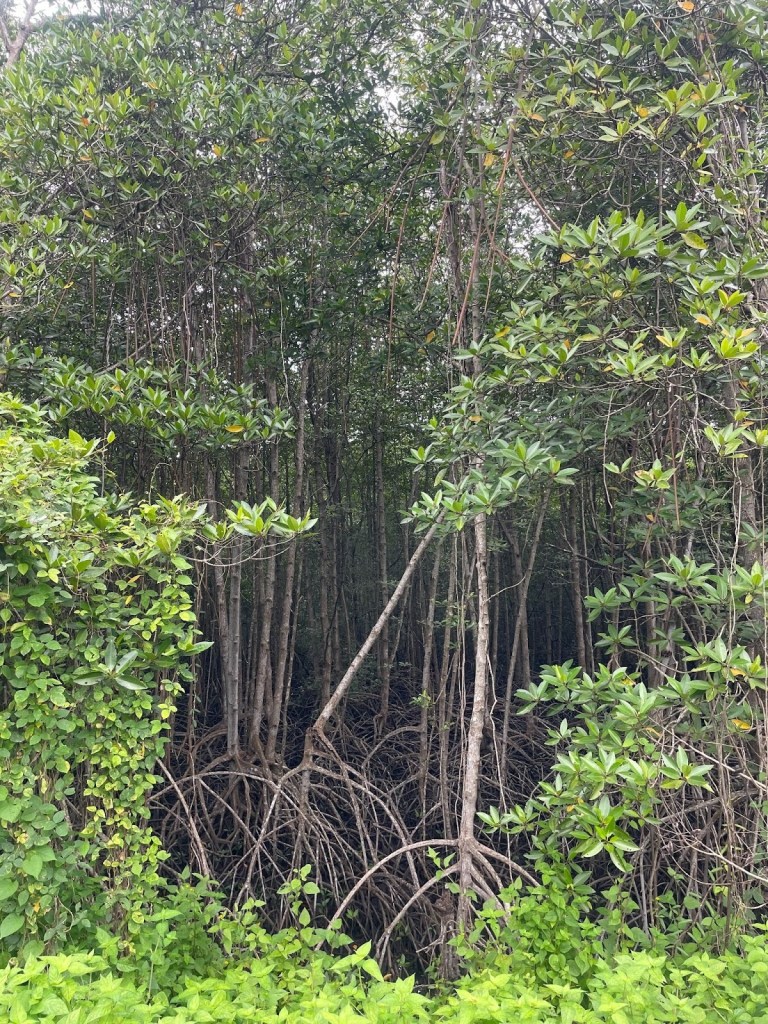
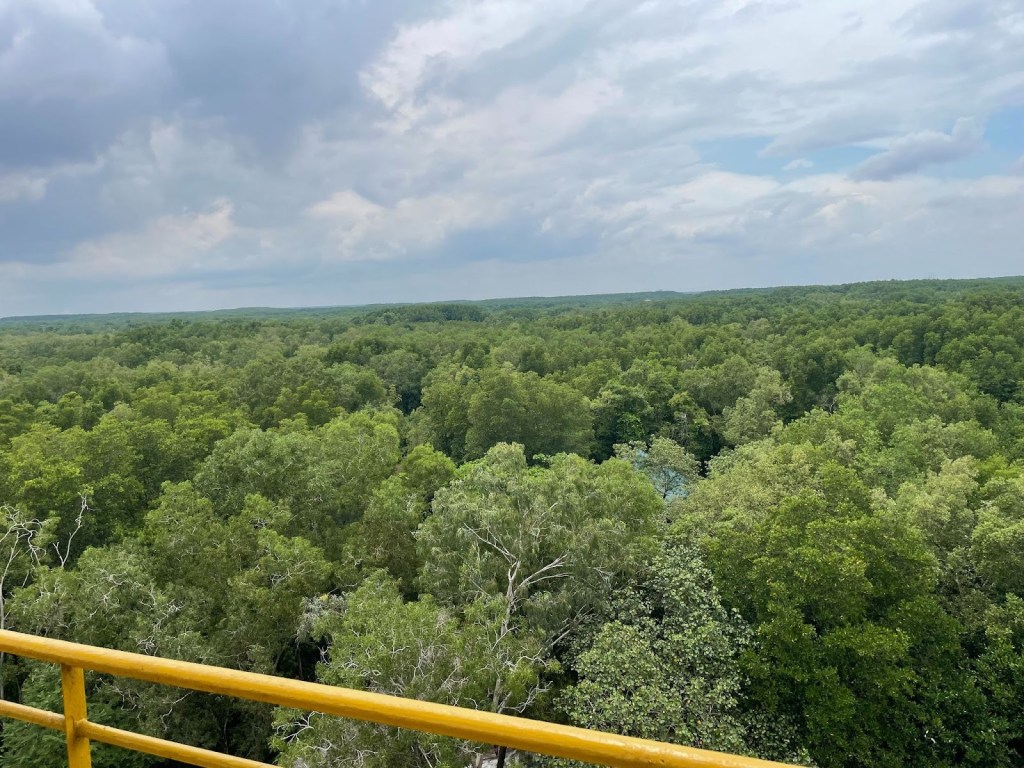
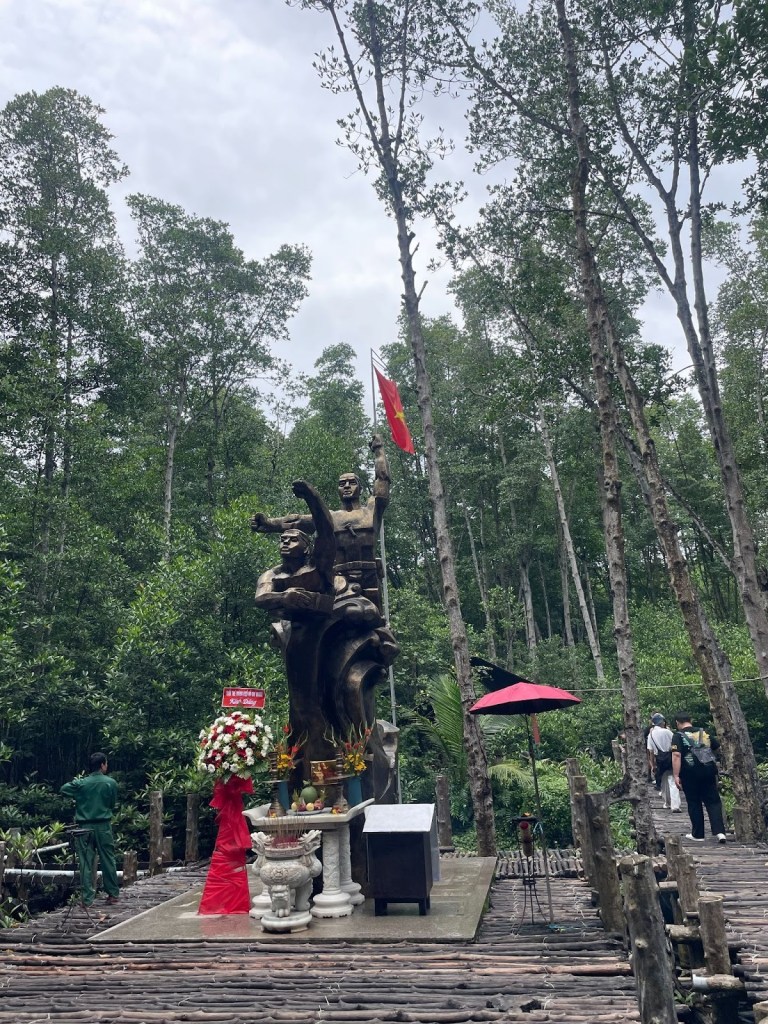
However, the forest holds a dark secret: most of these trees are not really “natural”, but rather were planted within the past 50 years following ecological devastation. During the Vietnam War (1955-1975), the forest was home to groups of National Liberation Front (NLF) commandos (the “Viet Cong”, as the Americans called them), who relied on cover afforded by the thick mangrove canopy and their knowledge of the labyrinthian tidal channels to launch guerrilla attacks against American and Republic of Vietnam (RVN) naval vessels. Given the strategic importance of the forest, bordering major riverine supply routes to the RVN capital in Saigon, securing the Rừng Sác became a priority for US military advisors in the mid 60s. Patrolling an area of this size, nearly 500 square miles with 3000 miles of tidal streams, presented a massive logistical challenge. The answer: simply remove the forest.
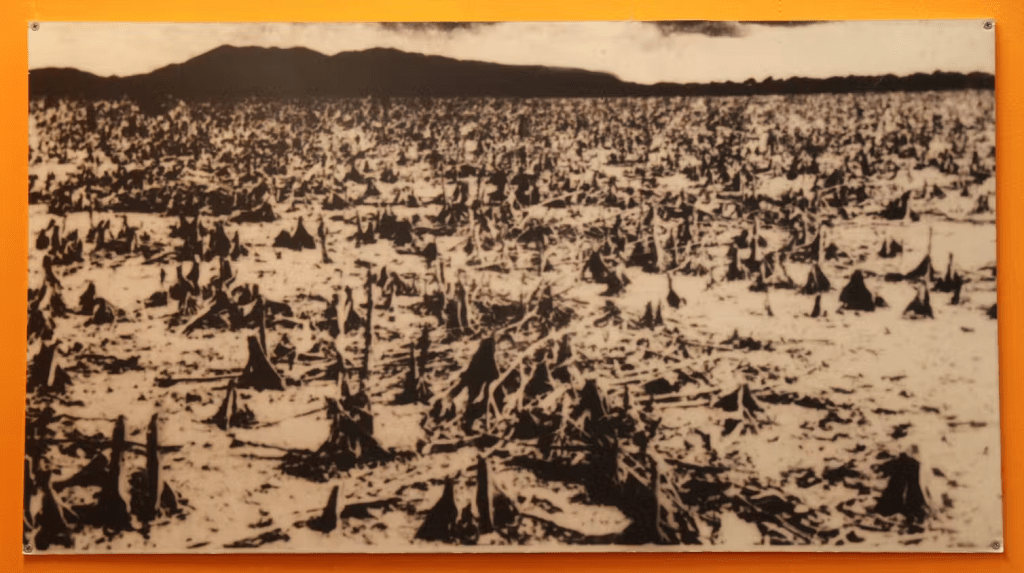
Encouraged by RVN president Ngô Đình Diệm, the Americans launched Operation Ranch Hand in 1962. This operation deployed the so-called “Rainbow Herbicides”, including the infamous Agent Orange, to improve ground operating conditions by defoliating large stretches of forest across southern Vietnam, Cambodia and Laos. By the program’s end in 1971, the US Air Force had sprayed 19 million gallons of chemical defoliants and herbicides across 5 million acres of forest [1]. Mangrove trees turned out to be especially vulnerable to herbicide application, often only requiring a single pass to be killed [2]. In Cần Giờ, the result was a denuded landscape. Where a mature forest had once stood, there now remained thousands of hectares of bare mud-flats, oxidizing under the tropical sun [3]. Looking at black-and-white images from the early 70s, it’s hard to imagine that they depict the same place as today’s lively forest.
After the People’s Army of Vietnam captured Saigon in 1975, uniting the nation following 30 brutal years of war, the new country now faced the monumental task of rebuilding its economy, society and environment. Restoration of the Rừng Sác fell on that early agenda. Starting in 1979, the new government began a mass mobilization campaign to replant the Rừng Sác. The destruction of the forest was so complete that propagules had to be shipped in by boat from the Cà Mau peninsula 200 miles away [4]. The government relied on youth volunteers from the city, local people from fishing villages in Cần Giờ, and former RVN officials held in “reeducation camps” (Vietnamese: trại cải tạo) to manually plant 30,000 hectares between 1978 and 1991 [5]. Initially, this mass campaign had less to do with what the burgeoning environmental movement of the 70s might recognize as “environmental values” than with economic necessity. While the government recognized the ecological value of the forest and its importance for local people, the main push for restoration was a plan to harvest mangroves for construction poles, wood chips, firewood and charcoal to fuel the reconstruction of the South, reshaping the Rừng Sác more in the image of a large industrial plantation than a forest [4].
The fate of the forest turned with the fate of the new nation. As Vietnam moved away from a centrally-planned economy towards integration with the international market economy following the Đổi Mới reforms in the late 1980s, new ways of valuing nature began to circulate. This was a time of ecological paradoxes in Vietnam: a shift towards export-oriented development kicked off ecological degradation, including large-scale conversion of mangroves to shrimp ponds in many parts of the country [6]. However, it also opened the door to exchange with international scientific and conservation organizations [7]. The Rừng Sác increasingly became associated with the emerging ecosystem services paradigm and parts began to be set aside as conservation areas [8]. By 2000, the Rừng Sác was declared a Mangrove Biosphere Reserve by UNESCO, officially marking the end of the plantation period. Continuing a global trend towards decentralized environmental management, local people were recruited as “forest managers”, receiving a monthly salary to patrol the forest and guard against illegal logging [8]. The explosive growth of the Vietnamese economy from the late 90s to the present, centered on Ho Chi Minh City, created a whole new Vietnamese middle class, allowing for the steady growth of eco-tourism in the forest. The Rừng Sác had been reborn.
Stopping by a shaded roadside stall for a cup of instant coffee, I reflected on this complicated history and the meaning of the trees. Mangroves are tricky things to pin down. They exist on the margins, thriving in the muddy terrain that marks the blurred boundary between land and sea. And here, the history of the Rừng Sác represented an even more ambiguous entanglement of economy, violence and power across multiple scales. Within the scope of 60 years, the landscape has been interpreted and acted upon in drastically different ways: A military threat, the “Forest of Assassins” as the American military called it, producing NLF guerilla ambushes and just as soon swallowing them back up into the shadows of the tidal creeks. A symbol of the hubris of an international hegemon, unleashing unprecedented levels of destruction against the physical landscape in an attempt to stop the “domino effect” of Communism’s spread in Southeast Asia (and, in the process, spawning the modern concept of “ecocide”). An industrial plantation produced through a massive governmental planting campaign, one imbued with both post-war patriotism and coercion. A precious and fragile ecosystem, sheltering biodiversity and storing carbon. Or a critical piece of infrastructure, the “green lungs” which regulate the climate of Ho Chi Minh City and shield it from coastal storms. The Rừng Sác contains all of these things. To the many local people I met, selling Nipa palm fruit and mud crabs on the side of the road, growing oysters on floating rafts and leading tours on outboard canoes, the forest is also home.
As students of the environment in the School of Marine and Environmental Affairs (SMEA), it’s important for us to remember the ways that we imagine “nature”—the values we assign it and the stories that we tell about it—have consequences for the ways that we act towards it. They are also historically situated and ever-changing. Here in the United States, we tend to imagine nature as something that exists externally to human society: the purity of the untouched mountain peak and the old growth forest, a terra nullius, or “nobody’s land”, vision of New World nature that reflects America’s violent colonial past. What logically follows is the “fortress conservation” model, whereby large areas of the environment are cordoned off from human activity for the sake of environmental protection (after first forcibly evicting the Indigenous inhabitants). This is not to say the goals of conservation are unimportant. Clearly action needs to be taken to prevent ecological damage. However, a rigid nature-culture dichotomy can often obscure the complex dynamics of human-nature interactions. Never is this more true than in our current era. In the Anthropocene, where human influence is ubiquitous, the line between nature and culture is destabilized. The Rừng Sác stands out to me as a particularly vivid example of the complexity of nature in the Anthropocene, an environment shaped just as much by Great Power politics and ambitious national rebuilding policies as by soil salinity and tidal range. The shared resilience of mangroves and people perhaps offers us a glimpse of hope of finding, as environmental historian William Cronon put it, an “ethical, sustainable, honorable place in nature” [9].
References:
[1] Zierler, D. (2011). The Invention of Ecocide: Agent Orange, Vietnam, and the Scientists who Changed the Way We Think About the Environment.” The University of Georgia Press.
[2] Committee on the Effects of Herbicides in Vietnam. (1974). The Effects of Herbicides in South Vietnam. National Academy of Sciences, Washington, D.C.
[3] Phan, N.H. (2004). Effects of mangrove restoration and conservation on the biodiversity and environment in Can Gio District. In: Mangrove management and conservation: Present and Future (Ed Vannucci, M.) United Nations University Press.
[4] FAO. (1993). Mangrove for Production and Protection. A Changing Resource System: Case Study in Can Gio District, Southern Vietnam. Regional Wood Energy Development Programme in Asia.
[5] Le, V.K. et al. (2005). Khôi Phục và Phát Triển Bền Vững Hệ Sinh Thái Rừng Ngập Mặn Cần Giờ Thành Phố Hồ Chí Minh (1978-2000). Nhà Xuất Bản Nông Nghiệp.
[6] Veettil, B.K. et al. (2019). Mangroves of Vietnam: Historical development, current state of research and future threats. Estuarine, Coastal and Shelf Science, 218.
[7] McElwee, P. (2016). Forests Are Gold: Trees, People and Environmental Rule in Vietnam. University of Washington Press.
[8] Vo, Q.T. and Kuenzer, C. (2012). Can Gio mangrove biosphere reserve evaluation, 2012: current status, dynamics, and ecosystem services. IUCN Viet Nam Country Office.
[9] Cronon, W. (Ed.) (1996). Uncommon Ground: Rethinking the Human Place in Nature. W. W. Norton & Company.
 Currents