Written by Isaac Olson
“The military and the monetary
Get together whenever they think it’s necessary
They have turned our brothers and sisters into mercenaries,
They are turning the planet into a cemetery”
“Work for Peace” by Gil Scott-Heron
This year, 2026, marks the anniversary of a very important moment in our history, when a rag-tag group of defiant colonized revolutionaries stood up against the premier navy in the world, and won. No, I’m not talking about the 250th anniversary of the American Revolution. I’m talking about the 50th anniversary of a struggle that was waged against the United States by a group of Hawaiians who would come to be known as the Kahoʻolawe Nine. It is a struggle that the University of Washington and its community should keep at the forefront of our minds.
Kahoʻolawe is one of Hawaii’s eight major islands, and while it is currently unpopulated, Hawaiians inhabited the island for over a thousand years prior to the arrival of white settlers. The island was highly valued by Native Hawaiians for both practical and cultural reasons, especially as a spiritual site and launching point for seafaring expeditions. However, with the arrival of western missionaries, explorers, and colonists, the island suffered gradual environmental degradation. Following the overthrow of the Hawaiian Kingdom in 1893 and the official annexation of Hawaii in 1898 by the U.S. Government, more and more land began to be claimed by settlers and the settler government. This included land stolen by the U.S. military, which began constructing bases as soon as 1899. Today, the U.S. military owns around 6% of all Hawaiian land, the highest percentage of any U.S. state.
The island of Kahoʻolawe was annexed by the military during World War II, and was retained for decades, simply because the military believed it was “too small, too dry and too eroded” to be used for anything other than target practice. Thus, Kahoʻolawe was bombed repeatedly over the years, including in Operation Sailor Hat, a series of detonations on Kahoʻolawe in 1965 meant to emulate the force of a nuclear bomb. The detonations were large enough to create a lake on the island, now known as Sailor’s Hat.
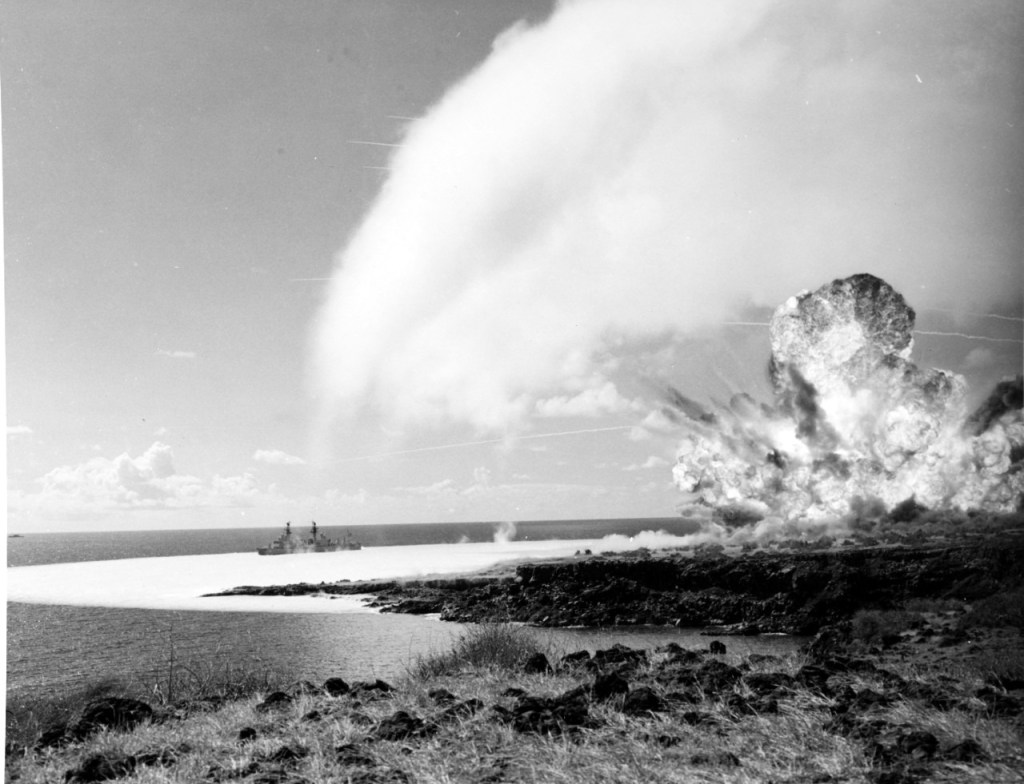
In 1971, U.S. military launched the Rim of the Pacific (RIMPAC) Exercise, a series of international naval wargames. RIMPAC involved navies from around the world coming together every two years to participate in war games in and around Hawaii, and the bombing of Kahoʻolawe was a common practice.
Enter the Kahoʻolawe Nine. In 1976, 200 years after America declared independence and started its own fight for sovereignty, a group of activists crossed the water from Maui, dodged the U.S. Navy’s blockade, and began an occupation of the island, becoming the first Hawaiians in decades to set foot on the island that had once belonged to them. Although the protesters were all detained within a few days, a movement was ignited, which would come to be known as the Protect Kahoʻolawe ʻOhana (PKO). Following the initial occupation in January of 1976, four more occupations would occur, as well as more than a decade of legal fights, political lobbying, and community engagement.
Despite opposition from the U.S. military, PKO’s work gained traction. Later in 1976, the Hawaii State Senate and House passed a resolution demanding that the U.S. government return Kahoʻolawe to the State. In 1980, the Navy was forced to grant the PKO stewardship over Kahoʻolawe, which gave the PKO limited use of the island, although bombings would continue until 1990. Finally, in 1994, the U.S. military returned Kahoʻolawe to the State, and began joint work on a cleanup.
Since then, Native Hawaiians have been able to return to the island to engage in environmental and cultural restoration, in an unprecedented win for the Hawaiian sovereignty and Aloha ʻĀina movements.
However, the destruction caused by the U.S. military has not been left in the past.
In fact, RIMPAC, the war games that were so essential in the routine bombardment of Kahoʻolawe, continue today across other parts of Hawaii and its waters. Dozens of militaries have participated, from Japan to Israel, with the justification that it is essential for military preparedness and cooperation, making RIMPAC the largest international naval exercise in the world. Modern RIMPAC exercises continue to be just as harmful to both the environment and Hawaiian sovereign rights.
For instance, RIMPAC 2004 resulted in the stranding of up to 200 melon-headed whales (and at least one death) due to the harmful effects of sonar. During RIMPAC 2018, the military accidentally started a 2000-acre fire within the Pōhakuloa Training Area, which is home to the most endangered species of any U.S. Army installation, with 10 plants and nine animals on the Endangered Species List. RIMPAC 2020, 2022, and 2024 have all involved the SINKEX program, in which the U.S. Navy sinks full battleships to the seafloor without disclosing or removing the toxins left onboard.
These exercises represent the brazenness with which the U.S. military operates, ignoring the environmental and social injustices that result from their actions. And now, such destruction is happening at the largest scale ever seen.
Without even accounting for purchased military equipment or long-term base operation, the U.S. Department of War (formerly the Department of Defense) annually emits around 50 million metric tons of carbon, the equivalent of 270,000 barrels per day, This means that today, the Department of War is one of the largest polluters in the world, emitting more annually than 150 entire countries. This is not just a recent phenomenon: between 2001 and 2017, the U.S. military emitted 1.2 billion metric tons of carbon emissions, making the Department of War the largest institutional emitter in the entire world.
And yet, in what seems at first glance as a paradox, the Department of War is a major supporter of climate research. The Pentagon was among the first to recognize climate change, funding research on it as early as the 1950s. The U.S. military continues to invest in climate adaptation initiatives, even under Donald Trump. Today, the Department of War contributes over half a billion dollars to geoscience research annually.
So we are left with a reality where both of these statements are true:
The Department of War is one of the largest emitters of greenhouse gases.
The Department of War is one of the largest funders of environmental research.
It is critical to examine our unique role in this dynamic at the UW, as the relationship between the U.S. military and environmental research has particularly flourished in academia. At one point, the Department of War was “the second largest sponsor of academic research in environmental fields.” Ever since the Cold War, the military has increasingly invested in geoscience out of a desire for technological superiority. This relationship has particularly flourished thanks to the U.S. Navy, which has been one of the major forces behind oceanographic research for decades to help gain tactical advantages, whether through better understanding of potential conflict zones (driving geoscience investment in the Arctic) or improving marine technologies such as submarines, torpedoes, and sonar.
During WWII, the U.S. military desired to expand its research and development efforts, and decided to partner with universities to do so. The first partner program was the Applied Physics Lab at Johns Hopkins University in 1942. The second was the University of Washington’s Applied Physics Lab (APL-UW), established in 1943. Since its inception, APL-UW has reported to and collaborated with the U.S. Navy, and is set apart as one of the very first Department of War University Affiliated Research Centers (UARCs). UARCs are research centers established in a partnership between a branch of the U.S. military and a university, which aim to provide the Department of War with cutting-edge research while siphoning researchers into a military career. APL-UW admits that it “accesses the broad expertise of a large and quality research university to address Navy issues, as well as helps educate the next generation of scientists and engineers, who are, in turn, exposed to careers in Navy-related R&D.” APL-UW has largely been successful in this initiative.
UW-APL’s contributions to the military include developing the Mark 9 Torpedo Exploder Mechanism and the Mark 45 Torpedo; acting as a leading expert on anti-submarine warfare; providing oceanographic information to inform the Naval Fleet’s tactics, strategies, and systems; and performing field research to inform the Navy’s tools for sensing within the battle environment.
APL-UW is unique, even among other UARCs, as it has a uniquely prominent presence at UW. APL-UW is physically found on UW’s campus (in Hendersen Hall and the Benjamin Hall Interdisciplinary Research Building), reports directly to central administration, and has strong interdisciplinary ties across campus. Today, APL-UW continues to receive about half of its funding directly from the US military, and while not all APL-affiliated researchers work directly on military science, the military is a routine presence in APL-funded work.
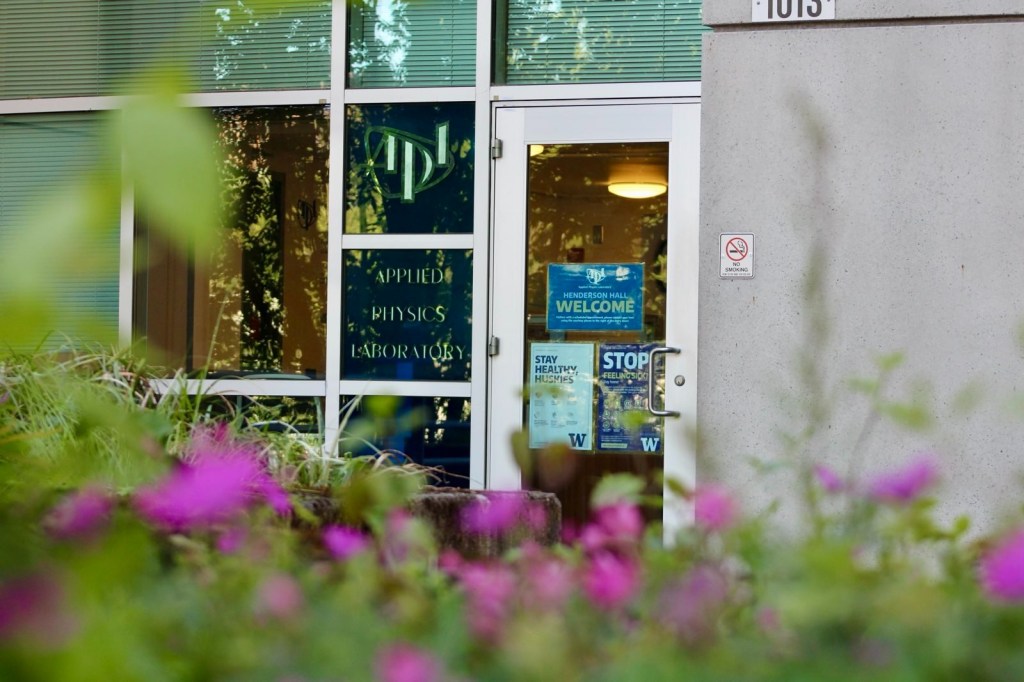
Notably, connections to the military are not limited to APL. In fact, they are seen all across the College of the Environment. One of the most stark examples is the Applied Fisheries Laboratory, a lab created in 1943 within the UW School of Fisheries (now the School of Aquatic and Fisheries Sciences). The lab was funded by the U.S. Office of Scientific Research and Development, a government department tasked with coordinating scientific research for military purposes, and its work involved “studying the effect of releasing the coolant water from the Hanford nuclear plant on the fish in the Columbia River.” However, at the time, this research was conducted “in secret,” and the link between the work and its military purpose was “disguised.”
By 1946, the Atomic Energy Commission took over sponsorship of the lab, just in time to implicate the UW in what would become known as “the world’s first nuclear disaster:” Operation Crossroads.
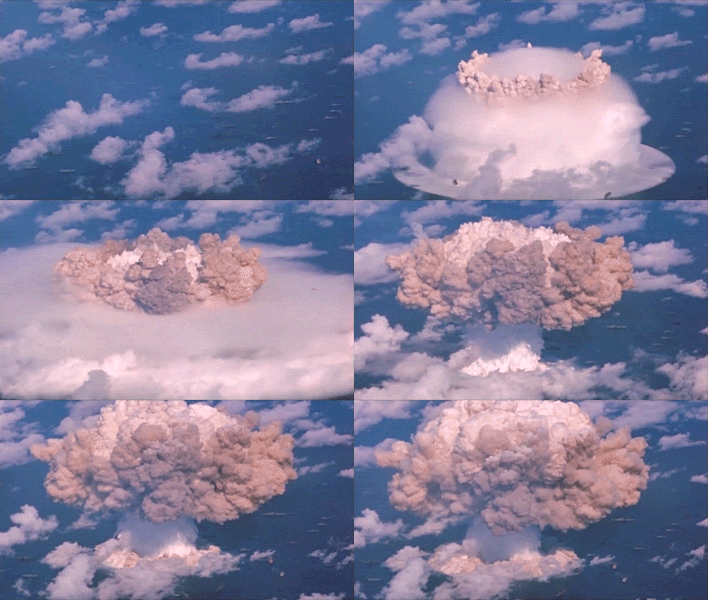
Following the dropping of the atomic bombs on Hiroshima and Nagasaki (by B-29 bombers which were tested at the University of Washington), the U.S. wanted to test the impact of a nuclear bomb on ships at sea. This test, which became known as Operation Crossroads, was planned to be conducted at Bikini Atoll, a coral atoll that the U.S. was ‘officially’ governing after claiming ownership over the Marshall Islands following WWII. After convincing the native inhabitants of the atoll to leave their home and relocate 125 miles away to Rongerik Atoll, plans to turn Bikini Atoll into a nuclear testing site commenced.
Many scientists, including J. Robert Oppenheimer, the Father of the Atomic Bomb, spoke out against the tests. However, some of the scientists who helped with the tests came from the Applied Fisheries Laboratory at the UW. Specifically, Director of the Applied Fisheries Laboratory Dr. Lauren R. Donaldson and Dr. Arthur D. Welander were “invited to assist in the tests” and travelled to Bikini Atoll to watch the bombs detonate and monitor the radiation as key members of the Operation’s Radiological Safety Section. Perhaps ironically, after two atomic bombs were dropped on the atoll in 1946, Operation Crossroads was cancelled because it became impossible to clean up the radioactive contamination of the ships and the surrounding lands and waters. Despite this warning of the impending environmental damage, the U.S. would end up dropping a total of 65 other nuclear bombs on, in, or above the Marshall Islands.
Meanwhile, the relocated residents of Bikini Atoll were facing starvation on Rongerik, as the U.S. military had left them without adequate supplies and the islands were not suitable for habitation, and wished to return home. However, due to the rampant levels of radiation, that was deemed unsafe, and instead, the land was turned over to the University of Washington, where Dr. Donaldson’s lab continued to run radiobiology tests for years. The lab was decommissioned in the 1980s, but Bikini Atoll remains unsuitable for habitation to this day, and many Marshallese are still waiting for justice while dealing with the dual threats of nuclear fallout and climate change.
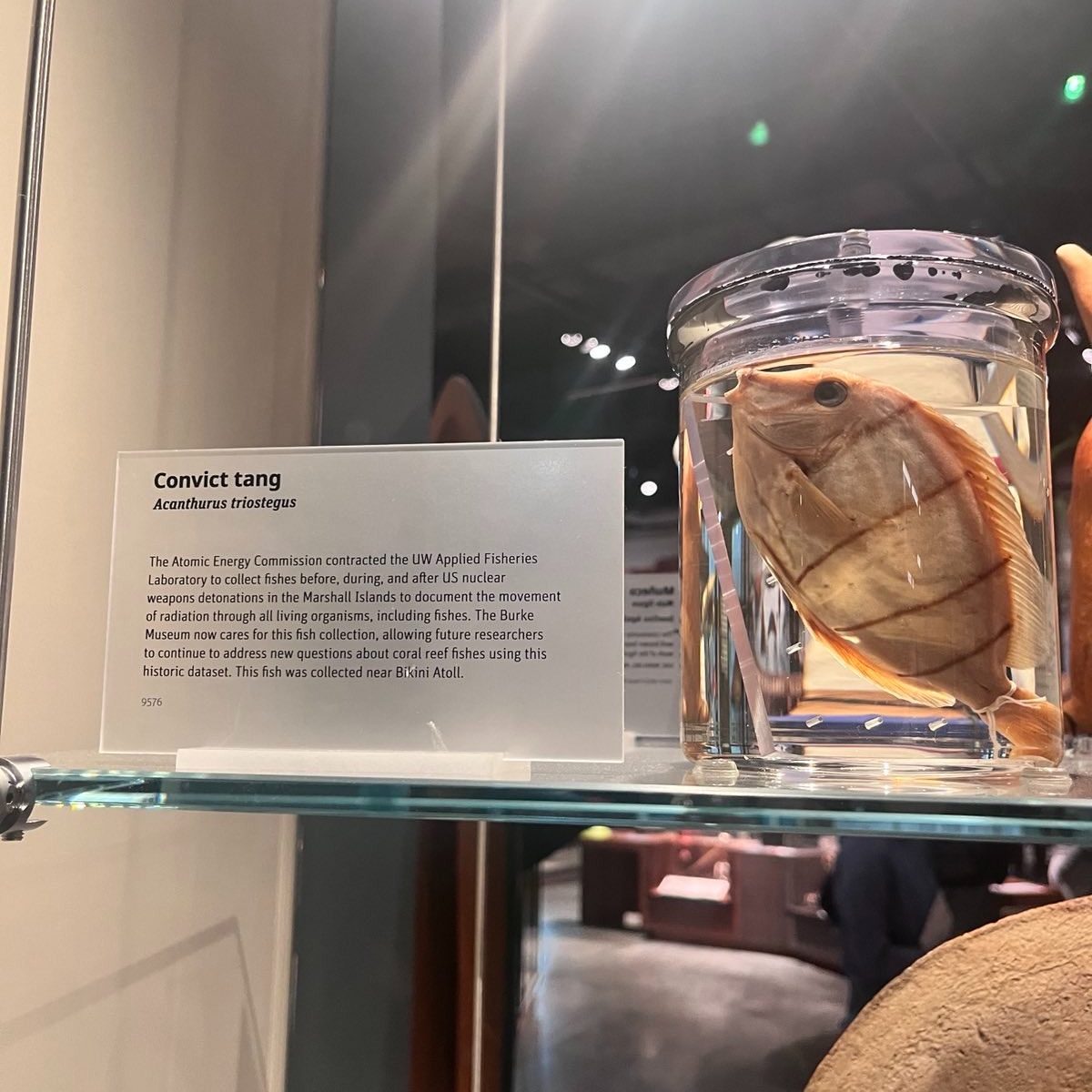
The UW’s role in these crises remains critically underdiscussed, being mostly consigned to the Burke Museum archives and the SAFS Fish Collection, where hundreds of fish collected from the Marshall Islands for radiation testing remain, rarely seen by anyone.
We are not free from complicity in the military-industrial complex within the School of Marine and Environmental Affairs (SMEA). Ties to the U.S. military permeate our program. Faculty in our program engage in studies partially funded by the Navy. Guest speakers tout their military backgrounds. The SMEA instagram account promotes alumni who work at a branch of SOUTHCOM, which is jointly overseeing the strikes on defenseless boats in the Caribbean in what experts deem a violation of international law.
I am routinely appalled by the fact that our campus is a breeding ground for global atrocities and that we collectively permit the U.S. military to so openly co-opt research and early-career researchers. Sometimes I struggle with understanding how we allow this uneasy, unethical partnership between the military and academia to continue.
I don’t struggle to understand the military’s reasoning. The Department of War’s support of environmental research is obviously not out of love for the environment. It is to gain tactical and technological advantages in combat, or, to use their more docile term, “national defense.”
But I struggle with why researchers within the field of environmental science remain complicit in upholding this dichotomy. I struggle with how our community justifies taking money from the institution doing the most harm to our planet in order to research and understand our planet better. I struggle with how our community allows military influence at universities, masquerading as academia when really it is an institution of imperialism.
However, I also recognize the plethora of justifications that resolve these seemingly opposing beliefs: I’m sure some people believe in what Wilfred Owen called “the old Lie: Dulce et decorum est / Pro patria mori,” that it is sweet and fitting to die (or sacrifice our moral hangups) for one’s country. I’m sure some people believe that “national defense” is a worthy cause. I’m sure some people believe that having the military as a force driving applied science results in better outcomes overall. Indeed, this is the ideal that drove the military-industrial complex’s involvement with science throughout the latter half of the 1900s and shaped the modern research landscape. I’m sure some people simply need money for their research, and so they are able to minimize the harm in their minds when the Department of War comes along offering funds. I’m sure that this has become even more convincing as the Trump Administration continues to slash funding for the other major governmental funders of geoscience research while increasing spending on the Department of War. I’m sure many people are able to do those mental exercises, and even come out believing that the good they are doing outweighs the level of harm they are complicit in. I’m sure that any and all of these are easier to do if you are not directly impacted by the harms being enacted by the U.S. military, especially because the military so often disguises itself and we so rarely dig deep into sources of funding. Being uninformed does not inherently make you unredeemable; in fact, you are not precluded from doing good work for good reasons. However, it does mean that there is a responsibility to recognize our privilege, to learn more, and once that happens, to make more informed decisions.
Not everyone gets to avoid thinking about the Department of War’s destruction. It was unavoidable for the Hawaiians who chose to protest their sacred land being hit with the force of a nuclear bomb while shouldering the brunt of the long-term environmental impacts. It was unavoidable for Koreans who chose to protest the construction of a U.S.-backed naval base on top of a conservation and cultural heritage site on Jeju Island, the same place where, 45 years before, U.S. forces had been complicit in the massacre of thousands of civilians for being alleged leftist sympathizers. It was unavoidable for the Filipinos who chose to protest their own local U.S.-led wargames, known as the Balikatan exercises, which have been similarly criticized for causing rampant environmental destruction.
Increasingly, it is unavoidable for all of us, because the Department of War is driving the climate crisis, and none of us are exempt from that.
The only exemptions have been for the U.S. military, at least when it comes to compliance with environmental laws and ethics.
When the Navy kills marine mammals, whether as part of RIMPAC exercises like in 2004, or as part of other operations, they face no significant legal reprimands due to exemptions in the Marine Mammal Protection Act. In fact, between 2018-2025, the U.S. Navy was permitted to kill, injure, or harass 12.5 million marine mammals without facing any punishment. RIMPAC 2026 is scheduled for this June.
Despite the investigation by the Korean government that found the U.S. complicit in the Jeju Island massacres, the government declined to confront the U.S. at all, fearing that it would damage relations between the countries. The Jeju Island Naval Base opened in 2016.
Agreements between the Filipino and American government permit the U.S. to escape accountability for not just environmental destruction, but crimes committed by U.S. servicemembers abroad. Balikatan 2026 is scheduled for April.
Each of us pursuing a career in geosciences is faced with a question: How long can we tolerate the Department of War? How much money is enough to tolerate our science being applied to weapons and destruction? If we, as scientists continue to be complacent, to allow the military not only to infiltrate our spaces but to dominate and control them, then how long can we continue to claim to be doing science rather than warfare? To be enabling destruction and not conservation?
The Department of War has, for decades, followed a pattern of permitting and enabling massacres under false pretenses. My heritage as a Filipino-Korean is built on this premise. We have seen it daily in Palestine and Latin America. And now, the Department of War is doing the same in the environmental science field, hiding behind the visage of research while enacting genocide and driving climate doom. So far, many scientists have paved the way for this destruction, through technology, reputation laundering, and complacency. Geoscientists have too often been paid just enough by the Department of War to not think about the true cost of complicity. But it is not too late, and now is time for us to push for lasting change and accountability.
Securing accountability can, of course, not be done by us alone. It will require strong action by governmental leaders, international organizations, and intergovernmental panels. But those bodies are often unwilling or unable to act, so the only true accountability comes from the people. It comes from researchers who reject military funding when they have the choice. It comes from the students, faculty, and administration who denounce their university’s willingness to allow the U.S. military to operate out of their campus, scooping up early-career researchers with whispers of research funding and no explicit connection to military use in their deliverables, conditioning us to accept the military as a trustworthy steward of our research. And it comes every day, when we are willing to call for demilitarization, to speak out against the U.S. military’s attempts to parade itself around as a force for good even as it is bombing the ground out from beneath our feet.
However, accountability is not just tearing down the status quo; we must commit to building with the communities who are experiencing frontline impacts from historic and ongoing injustices. We must be willing to think beyond just conducting science, and treat the communities impacted by science as partners rather than specimens. Notably, the hundreds of fish from the Marshall Islands in the SAFS Fish Collection, present an opportunity for the UW to tangibly make this change. Currently, the specimens, collected beginning in the 1940s to study the impacts of nuclear radiation on fish, are largely unused. But anthropologists in the Burke Museum’s Research Family program, which allows student researchers from the Pacific Islands to reconnect with “Indigenous Oceanic knowledge, values, and languages in collections-based research” are modeling the sort of reparative research that could be done if marine scientists were willing to put effort into engaging with the communities we have harmed. Even though the collection has been managed with care by SAFS and Burke Museum faculty, allowing the fish to sit invisibly in our archives is just another form of erasure and dispossession, and so, we must do more.
As marine and environmental researchers, it is important to take ownership of these historical wrongs, and work towards forms of reparation. We should be actively uplifting the visibility of these issues, supporting the students and organizations attempting to achieve justice, and working to ensure that data taken from communities under occupation can be reunited with people from the communities they were taken from. Because in this year, the 80th anniversary of the nuclear testing in the Marshall Islands, it is high time that we began to actively demilitarize and decolonialize our field. After all, how many more anniversaries must pass before we commit to justice?
It is no mistake that the Kahoʻolawe Nine’s occupation occurred in January of 1976, the beginning of the United States’ own 200th anniversary. At the time, Native Hawaiians were facing land dispossession, ecological destruction, and erasure of cultural and political sovereignty. The protesters very much understood that they “could elevate Hawaiian issues onto the state and national agenda” by taking daring action against the military in the name of the land and waters they protected for centuries. Their actions required a willingness to reject the idea of complacency, of safety, of fear, for the sake of love for the land, Aloha ʻĀina.
During one of the occupations, activists George Helm and Kino Mitchell would disappear in the waters between Kahoʻolawe and Maui, giving their lives to protect the land and water that they loved from continued destruction. Before his disappearance, Helm emphasized that:
“We are spending a lot of money to kill people, that’s the trend, that’s been the trend for 200 years, 300 years” and asked “When are we gonna start changing it?”
I believe it should be today.
Peace ain’t gonna be easy.
Peace ain’t gonna be free.
We’ve got to work for peace.
“Work for Peace” by Gil Scott-Heron
 Currents
