Written by Kailani Dial and Jo Harris
It’s Crabbing Season
With summer just around the corner, crabbing season is almost upon us. Serving as a signature seafood in Washington, Dungeness crabs (Metacarcinus magister) are a popular species for commercial, subsistence, and recreational harvest. As the highest-grossing fishery in Washington, these crustaceans have long been a source of income, nutrition, and recreation for tribal and nontribal communities alike. Crabs are a pertinent part of Indigenous traditions, community gatherings, and cultural teachings rooted in respect for the natural world. They are also important to diverse communities along the West Coast, where the complex art of crabbing is passed down from generation to generation.
The Washington commercial fishery for Dungeness crab has generated an average of $46 million per year since its inception in 1990. Additionally, more than 200,000 recreational licenses are sold every year, yielding a harvest of around 1,500,000 pounds of Dungeness crabs by sport fishers. That’s a lot of crab! The fishery attracts both tourists and locals alike, but navigating licenses, area closures, gear restrictions, and more can be challenging for people who are just getting started. If you are looking for a family-friendly summer activity, here is your go-to guide on recreational crabbing in the Puget Sound.
Important note!!
Regulations on fishing gear can change frequently, so always check the Washington Department of Fish and Wildlife website for the most up to date information. Also, different areas of Washington have different regulations and licensing requirements, as do other states. This guide is strictly for the Puget Sound and should not be used to inform crabbing in other locations.
If you’re going out crabbing, always check weather and marine conditions, operate boats in accordance with all applicable laws and regulations, and exercise good judgement for everyone’s safety.
Seasons, Licenses, and Catch Report Cards
First, ensure that crab is in season. There are two seasons for crabbing in Puget Sound, with the winter season extending from October to December, and the summer season running from July to August. The specific date of season openings can be found on the WDFW website.
The next, and very important, step to crabbing is ensuring that you have the proper license. Any crabber over the age of 16 must obtain both a Dungeness crab Catch Record Card (CRC) and a shellfish/seaweed license or a combination fishing license. If you are under 16, a CRC is still required, but you will not need a fishing license. CRCs are used to keep track of the number of Dungeness crabs that are caught throughout the season. It is imperative that all recreational fishermen report their catch – even if that number is zero – as CRCs inform future quotas and crabbing opportunities for all recreational fishers.
Catch can be recorded in two ways:
- You can return a physical CRC card by mail to the address printed on the CRC or by hand to any regional WDFW office.
- CRCs can also be submitted via your mobile device through the my WDFW or Fish Washington mobile app.
Summer season CRCs must be returned by October 1st, while winter season CRCs must be submitted by February 1st.
Gearing up
Now you’ll need some gear. When just starting out, there is no need for anything special or fancy. You can start by simply attaching bait to a fishing line and casting from a dock or pier. If catching crab this way, it will be useful to have a dip net ready to scoop up the crab as it comes to the surface. If you are an avid diver, catching crabs with your hands is also an option. It is important to note that when using any hand-operated equipment, it is illegal to pierce the shell of the crab or use poison or chemical irritants.
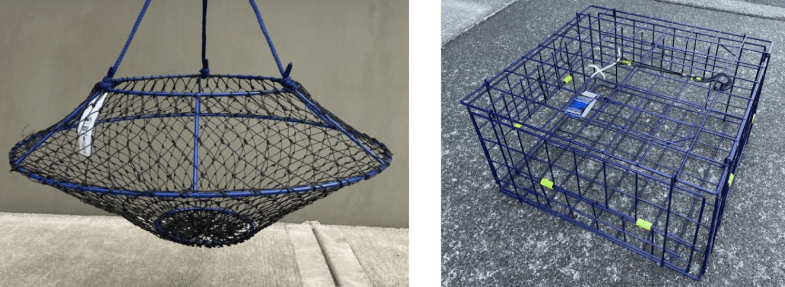
If you want more advanced equipment, you can try using pots, ringnets, or star traps (See Figure 1). In the Puget Sound, each crabber is allowed to have two units of gear. One dipnet, crab pot, star trap, or ring net is considered one unit of gear, so you can have up to two of these items per crabber. If you decide to use a star trap, ring net, or crab pot, you will also need a crab pot line to drop and retrieve your traps. WDFW requires either a sinking line or weights to be placed on your crab pot line. This will prevent your lines from floating to the surface and getting tangled in boat propellers. When deciding how much line you will need, you will want to account for tides, currents, and the depth of your pot. Having the proper amount of line will help you avoid gear loss. A good rule of thumb is for the length of your line to be 1.5 times the water depth where you set your pot.
If you are planning to leave your gear unattended– like when leaving the crab pot to sit for multiple hours– you will need to permanently and clearly mark a buoy with your first name, last name, and permanent address. The buoys must be half red, half white, made of durable material, and be visible from the surface of the water, unless there are extreme tidal conditions. Additionally, WDFW requires that crab pots have a minimum mesh size of 1.5 inches, two escape rings that are 4.25 inches in diameter, a volume less than 13 cubic feet, and an escape cord made of biodegradable or rot material.
Setting your traps
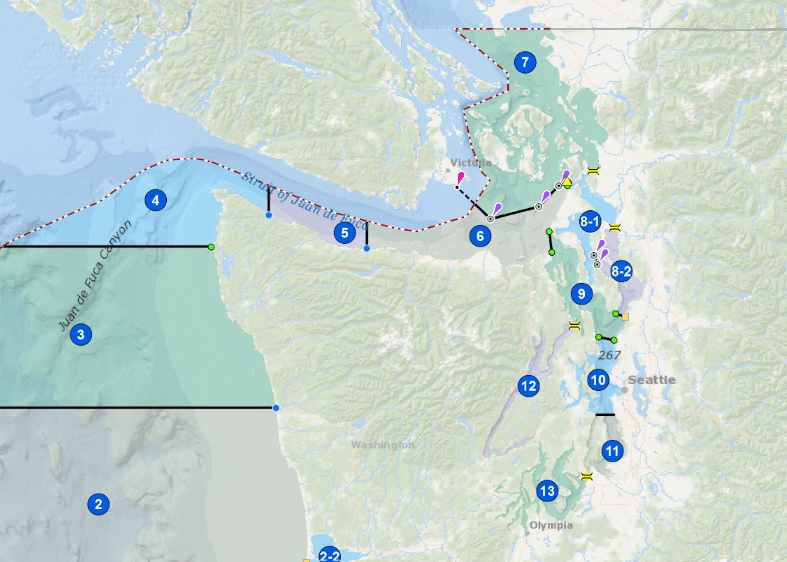
It’s time to hit the water and set your traps! In the Puget Sound, you can generally crab in marine areas 5-13, which include the Strait of Juan de Fuca, San Juan Islands, and Hood Canal, or you can crab east of the Bonilla-Tatoosh line in marine area 4. Please refer to this map for more details (Figure 2). However, there may be area closures that vary from year to year. Before heading out, check the WDFW website to see which areas are open for crabbing.
Because there are hundreds of miles of coastline to choose from, you will have to experiment to find your favorite spot. Generally, you want to look for locations with gently sloping sandy bottoms, muddy flats, or near eelgrass beds. Areas near the mouths of rivers or streams or protected bays can be good for crabbing. You can also set your traps off of piers, docks, or seawalls. However, you cannot set your traps within 400 ft of a ferry terminal, at the entrance to a marina, near boat launches, or off of private docks – unless you have permission by the owner. Having trouble finding a pier? Check here!
Looking to ditch the shoreline and head out into the water? Dungeness crabs can be found at depths greater than 750 ft, but most recreational crabbers don’t venture past 150 ft. It might seem like you need a fancy boat to go crabbing; you don’t! If you plan to set your traps farther out from shore, a paddleboard or kayak can work just as well. If you are heading out into the Puget Sound, check marine conditions in advance. You want to avoid setting traps when there are strong currents or tidal waves, as bad weather conditions can lead to gear loss. When it’s time to drop your traps, don’t be afraid to try different depths to see where the crabs are biting!
Before setting your traps, make sure you have the right bait. Even though Dungeness crabs are generalists, they definitely have their preferences. Dungeness crabs cannot resist fish carcasses, squid, or clams, but chicken or turkey will also suffice. You’ll also want to check your watch before dropping your pot. In Washington state, crab traps cannot be set or retrieved from one hour past sunset to one hour before sunrise, so make sure you have time to drop, soak, and retrieve your pot! To avoid gear loss, set your traps away from heavy boating traffic or shipping lanes, and add 5-10 pounds of weight to the bottom of your trap. When you are crabbing, you will likely see other people’s buoys already out on the water. Follow good crabbing etiquette and do not set your traps right next to others. You want to avoid tangling your gear, so leave about 100ft of space between traps. There are enough crabs to go around, so give your fellow crabbers some space. When you set your trap, you want to give crabs time to take the bait. This is known as soaking time. Soaking your trap for longer isn’t necessarily better, but you’ll want to let your trap soak for at least 15 minutes. Some crabbers prefer to soak their traps for a few hours. However, don’t wait too long before you check your traps! Dungeness crabs are cannibalistic, so you might come back to only one crab…
Swipe Right? Keeping or Discarding Your Crab
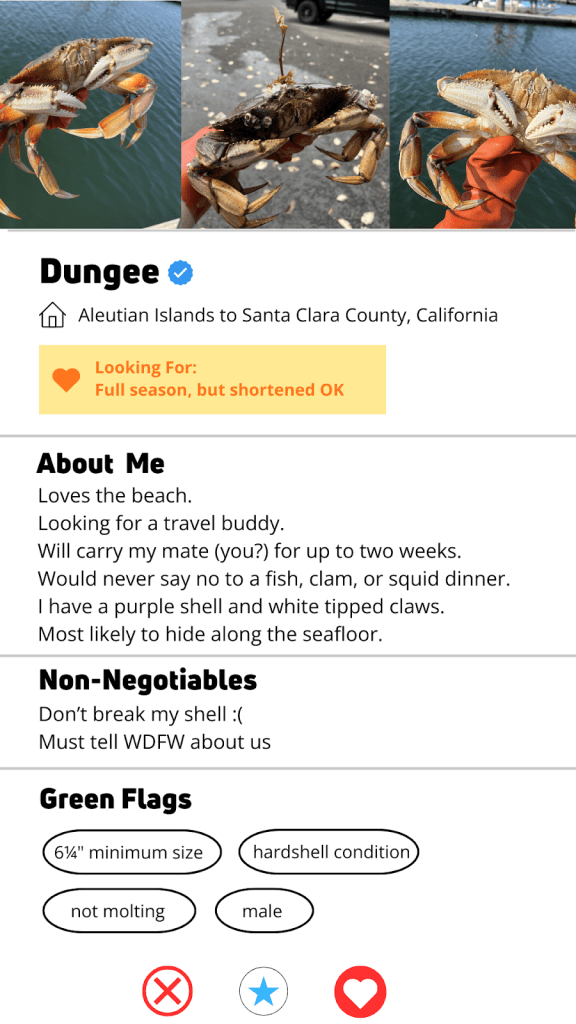
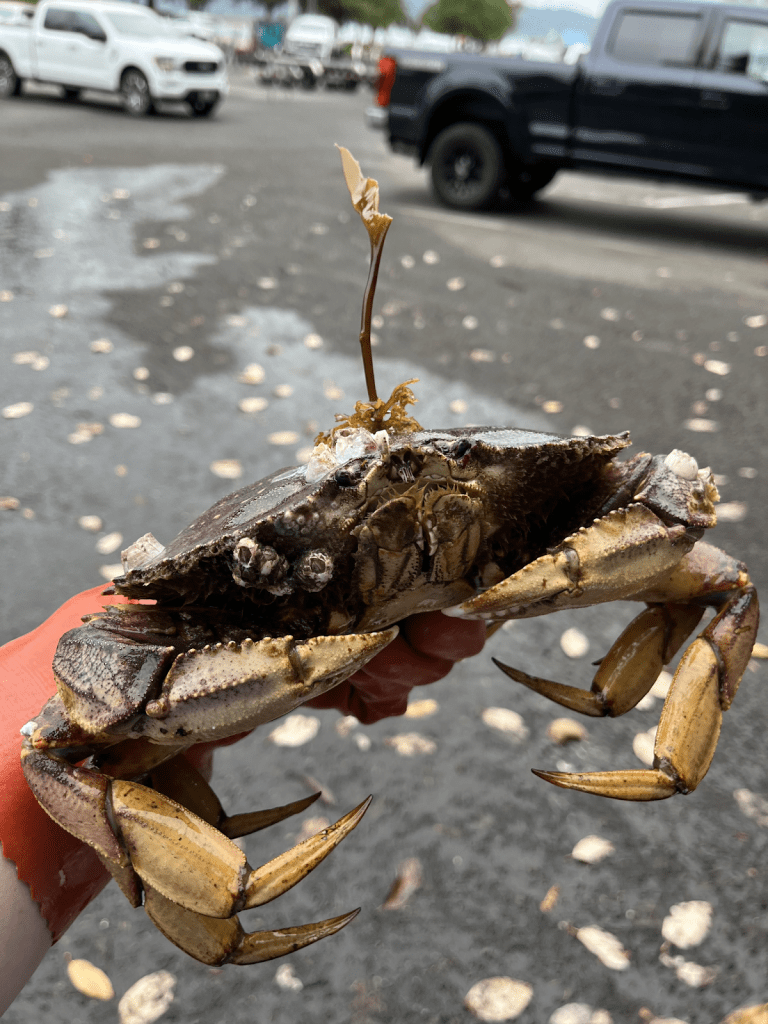
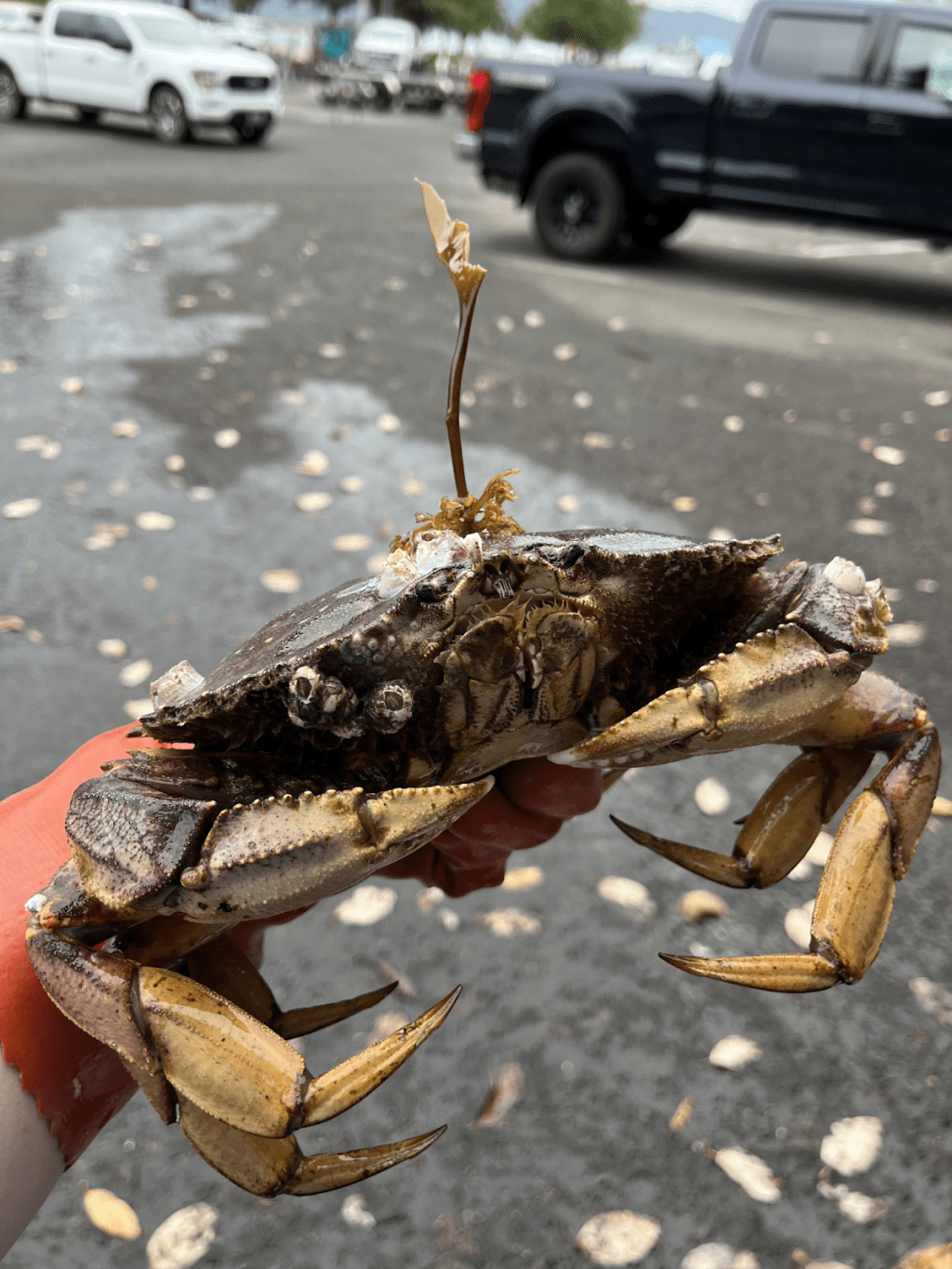
One of the most important things to know when crabbing is which crabs you can keep and which ones you need to throw back. First off, what does a Dungeness crab look like? There are many crab species that call Washington home, so it is important to know how to identify them. Dungeness crabs are known for their purple shells, white-tipped claws, and the 10th spine on their shell being their widest section. They are generally larger than other crabs, with shells measuring up to 10 inches.
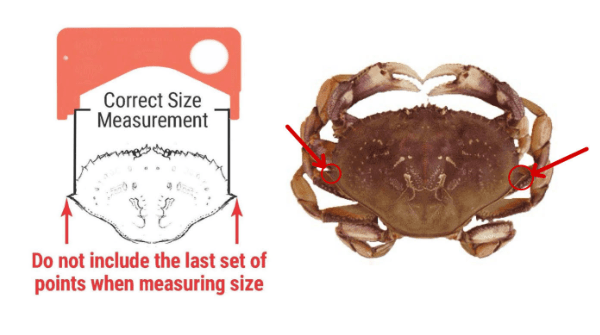
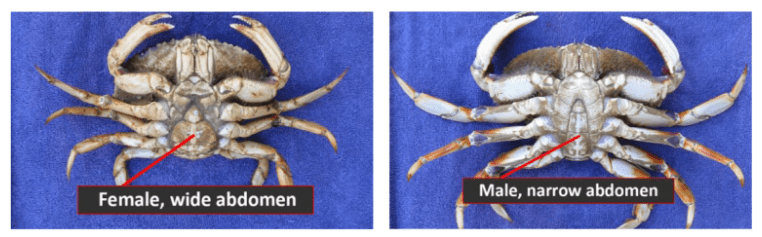
Now that you know how to find Dungeness crab, which ones can you take? Dungeness crab management uses what is called the ‘3-S’ system – size, sex, and season. For Dungeness crab, only males measuring more than 6.25 inches can be harvested at specific times of year. To measure a crab, count to the 10th spine on either side of the carapace. Use a crab caliper to measure the distance inside the 10th spine (Figure 4). Do not include the tips of the spines in your measurement. Using a ruler or other measuring device will likely give you inaccurate results, so ensure you have the right equipment on hand. Male Dungeness crabs are distinguishable by their narrower and columnar-shaped abdomen flap on the underside of their bodies (Figure 5). Because female crabs are critical for the continued success of Dungeness crab populations, it is illegal to retain any female crabs. Furthermore, all crabbers must release all crabs with soft shells. Crabs that are currently molting, or ‘shedding’ their exoskeleton, are incredibly vulnerable and vital to the reproduction of Dungeness crab. So, if your crab is smaller than 6.25 inches, female, or molting, you will need to release it back into the water. If your crab meets all requirements, each licensed crabber can retain up to 5 crabs per day.
Transporting crab
So now you have your crab, but what is the best way to get them home (and into your steamer!)? Crab must be cooked while alive or within a few hours after death. When they die, their bodies release enzymes from their liver that can turn the meat sour incredibly fast. Therefore, you must make sure you have the proper setup to ensure your crabs stay cold from catch to kitchen. To transport your crab, you will need three things: a cooler, ice, and a few old towels.
The first step is to line the bottom of your cooler with about two inches of ice. You can use more if needed, just use your best judgment. If your cooler has a drain plug, make sure it is open to allow the melting ice water to flow out. When crabs are pulled out of the water, they switch to air breathing, so if the crabs become submerged, they will die from oxygen deprivation. If your cooler does not have a drain plug, make sure to periodically remove water.
Next, place the towels over the ice to create a barrier between the ice and the crabs. Direct contact can make crabs too cold and cause them to die. Then, place the crabs on top of the towels, making sure not to place them upside down or stack them. After doing so, keep the cooler lid cracked to allow air flow.
With this setup, you can keep your crabs for up to 24 hours, or until the ice melts. However, if you are transporting live crab, make sure to get rid of any crabs that have died in transit. As mentioned, they begin to spoil fast. After these easy steps, you can now start cooking up a nice crab dinner!
Lost your gear? Report it!
Did you return to your buoy and find that your crab trap has gone missing? Report it to WDFW, as they can assist with retrieving and returning lost gear. Additionally, if you see lost gear, report it to WDFW’s no-fault reporting system. Try to record as much information as possible, including coordinates, the type of gear, details of the sighting (time, date, size of the gear, etc.), and your contact information. Derelict, or lost, gear will continue to catch crab and fish, or entangle marine mammals long after it has been lost. Lost traps are estimated to kill 180,000 harvestable crabs annually in the Puget Sound alone. This continuous “ghost fishing” harms critical habitats, crab populations, and other marine life. Reporting derelict gear helps protect the Puget Sound and sustain its crab fishery.
Ready? Set. Crab!
At this point, you should be an expert on crabbing in the Puget Sound. It’s time to grab your gear and get out there! Ready? Set. Crab!